
Hope for Lebanon and for the world
By Andrea Tornielli
The possibility of coexistence among those who profess different faiths, and a fraternity that goes beyond ethnic boundaries and ideological divisions: this is what wounded Lebanon, the “country that is a message,” continues to show the world as a concrete possibility and a path toward peace.
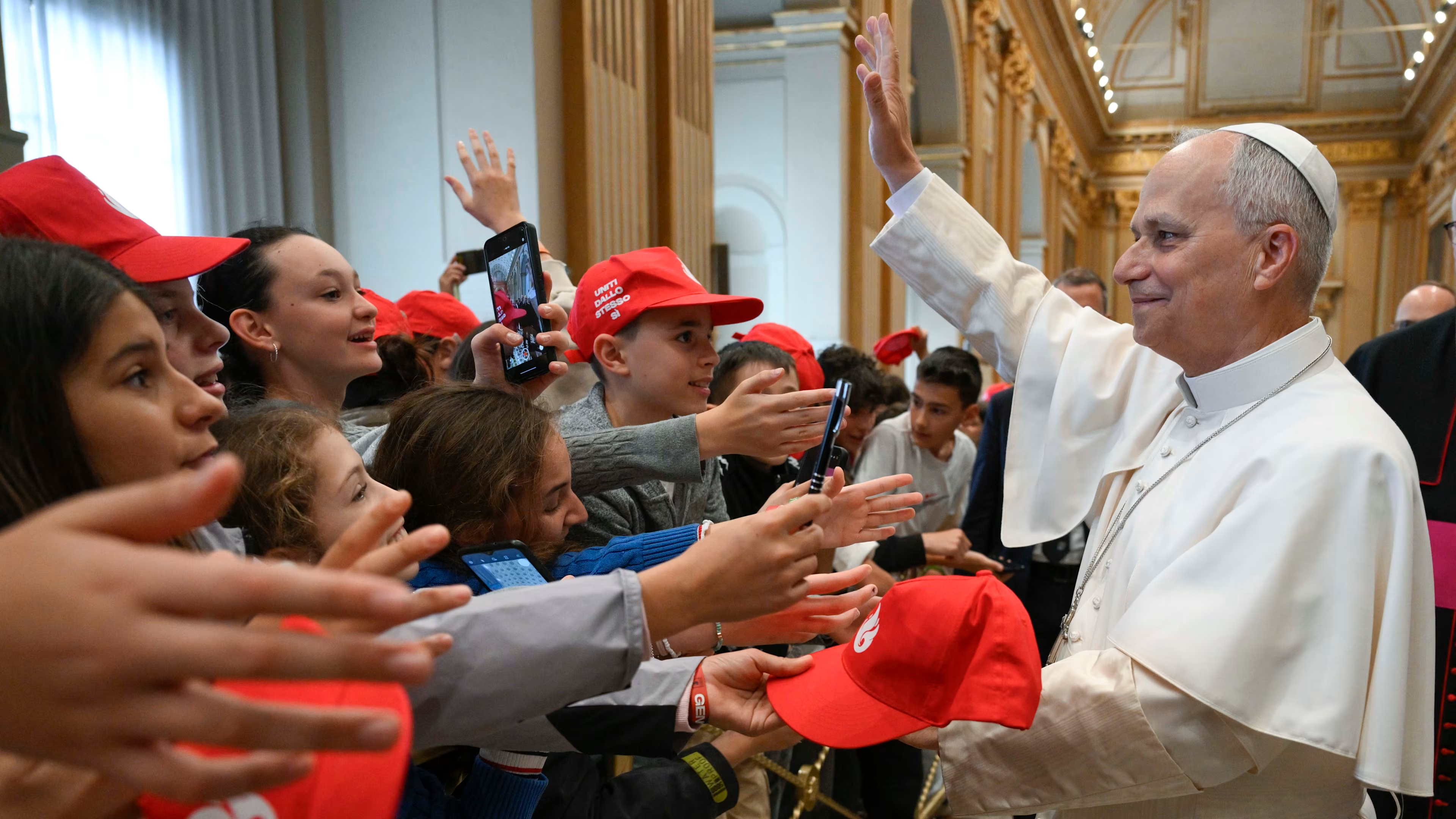
It is to this Lebanon, and to its hope embodied in young people who refuse to give in to war and hatred, Pope Leo pointed as a way to building the future.
Addressing thousands of young people gathered at the headquarters of the Maronite Patriarchate of Antioch, at the end of an intense day of meetings, the Successor of Peter said: “You have hope! You have time! You have more time to dream, to plan and to do good. You are the present, and the future is already taking shape in your hands! You have the enthusiasm to change the course of history! The true opposition to evil is not evil, but love – a love capable of healing one’s own wounds while also caring for the wounds of others.”
Some of those present had just spoken about this freely given love—love capable of healing the wounds of others because in their wounds we recognise our own, and above all because in those who suffer we recognise the face of God. Elie spoke of this: after years of sacrifices to save money as he studied while working, he saw his plans collapse because of the country’s economic breakdown, which caused him to lose everything. Yet he decided not to emigrate: “How could I leave while my country is suffering?”
Then came the moving testimony of Joelle, who, during a prayer gathering in Taizé, met a girl her age, Asil, also Lebanese but Muslim, who lived in southern Lebanon. When Asil’s village was bombed during Israeli raids, she turned to Joelle because her family no longer had anywhere to go. Joelle and her mother welcomed them: “The difference in religion never created a barrier… We lived in deep harmony… I understood a fundamental truth: God does not dwell only within the walls of a church or a mosque. God is revealed when different hearts meet and love one another as brothers and sisters.”
After her, Asil’s mother, Roukaya, spoke: “Joelle’s mother opened the door of her home to me and said, ‘ This is your home. She did not ask who I was, where I came from, or what I believed… I understood that religion is not something you declare; it is something you live in a love that crosses every boundary.”
What made all this possible? What foundation has enabled Lebanon to be what it has been and what it seeks to remain? Pope Leo identified a foundation that “cannot be just an idea, contract or moral principle.” The true principle of new and reconciled life “is the hope that comes from above: it is Christ himself! Jesus died and rose again for the salvation of all. He, the Living One, is the foundation of our trust; he is the witness of the mercy that redeems the world from every evil.”
Leo XIV’s first journey, which concludes today, Tuesday 2 December, with his return to Rome, helps to clarify the meaning of the words he spoke the day after his election, when the new Bishop of Rome said that anyone in the Church who exercises a ministry of authority must “disappear so that Christ may remain.” Words that apply to anyone who proclaims the Gospel. To leaders of other Christian Churches and to Muslim leaders from the diverse traditions that form Lebanon’s religious mosaic, the Pope recalled that this land witnessed episodes from the public ministry of Jesus. He cited in particular the encounter with the Canaanite woman and her faith as she sought healing for her daughter: “Here, the land itself becomes more than a mere site of encounter between Jesus and a pleading mother; it becomes a place where humility, trust, and perseverance overcome all barriers and meet God’s boundless love that embraces every human heart.”
To “disappear so that Christ may remain” does not mean withdrawing into inwardness, building closed communities of the “perfect,” or chasing dreams of power and greatness based on numbers while forgetting God’s logic, which is shown in littleness. To “disappear so that Christ may remain” means becoming instruments—despite our limitations—of that boundless love of God that embraces every human heart without distinction, bending down to the least, the oppressed, and those who suffer. This is what the young people of Lebanon bore witness to before the Successor of Peter, who came to encourage them.
The Author