
‘In the midst of 2 living saints’: Ohio bishop reflects on witness of Ukraine clergy
Bishop Earl Fernandes tells EWTN News English about his experience spending the day with wartime clergy from Ukraine in New York City.
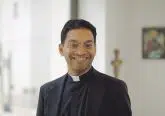
NEW YORK — Bishop Earl Fernandes of Columbus, Ohio, has moderated panels on war and persecution at the New York Encounter for the past two years, an experience he told EWTN News has greatly influenced the way he sees his role as a bishop.
At this year’s event, held Feb. 12–14, Fernandes moderated a panel hosted by Communion and Liberation titled “A Home in the Storm” with Bishop Pavlo Honcharuk of Kharkiv, Ukraine, and Father Wojciech Stasiewicz, director of Caritas-Spes of the Kharkiv-Zaporizhia Diocese.
Previous panels Fernandes moderated featured priests from India and Myanmar as well as a bishop from Nigeria.
Fernandes told EWTN News in an interview at the event about the time he spent with the Ukrainian bishop and priest before the panel, what he thinks about their witness as wartime faith leaders, and what he took away from the experience as a bishop who “lives in comfort.”
‘I wanted to reach out and just touch him so I could be holier’
“I never met them before this morning,” Fernandes said of Honcharuk and Stasiewicz the day of the panel, noting that they could only communicate through a Polish-language translator. “I wanted to find out what is the reality there, [because] sometimes what we see on the news [is] only a short clip.”
Fernandes said Honcharuk described to him the “devastation of war on individuals and families,” and how power outages across the country have impacted the lives of Ukrainians as temperatures dip well below freezing.
“It’s very moving to see in the face of the crisis how the faith is actually being lived,” Fernandes said, reflecting on what the Ukrainian bishop told him. Despite living in constant fear, he said, Ukrainian Catholics have transformed every parish into a Caritas center.
“As I was moderating this panel, I began to think of the men who were behind the Iron Curtain, whom I knew as a child, like the bishops and priests who suffered or were imprisoned, who were true confessors of the faith,” Fernandes said. “I wanted to reach out and just touch him so I could be holier.”
Fernandes is the son of Indian immigrants who came to the U.S. in 1970. He said that during his childhood, he knew people who had relatives behind the Iron Curtain who suffered greatly. He has been bishop of Columbus since May 2022 and has been involved with the Italian movement that organizes the New York Encounter, Communion and Liberation (Communione e Liberazione), since 2004.
Fernandes noted that throughout the panel and his visit, the Ukrainian bishop’s message was never about political pressure or asking for financial assistance from the U.S. “What [was] at the center of his message [was] Christ, ultimately.”
Though Fernandes said it would be easy to start thinking of the Church as a social system rather than a religion in the current situation in Ukraine, he praised Honcharuk for centering his message on Christ and being willing to die for his people.
As bishops, Fernandes said, “we give our consent [to die] all the time, but do we understand the implications of our consent? What does it mean to be baptized, to be immersed in the life of the Trinity? What does it mean when you’re on the floor prostrated?”
“You’re saying, ‘Yes, I’m a priest; I’m configured in Jesus Christ,” he continued. “I am ready to embrace the cross in that way for the sake of my people to be a good shepherd.”
This reality is what Fernandes said he witnessed in his encounter with Honcharuk and Stasiewicz. “We see how much, in fact, Christ has impacted their lives, and their own sense of helplessness also then makes them rely upon him even more,” he said.
Fernandes said that in addition to their humanitarian work, he spoke with the Ukrainian bishop and priest about what they are doing to combat “invisible forces.”
“I had been an exorcist in the Archdiocese of Cincinnati, so I asked the bishop, ‘What have you done?’ and he said, ‘I authorized all of my priests, and I myself went over the whole diocese because there are invisible forces that are bent on dominating us.’”
Fernandes said Honcharuk told him several stories of instances where he saw “the hand of God [and] divine providence” protecting the Ukrainian people. “In my conversation with them, it helped me to realize that there is divine providence, and God does have a plan.”
Personal influence
Tying their witness to his own life and ministry as a bishop, Fernandes reflected that while “it’s always easier to stick our head in the ground or to live in a fantasy world with lots of illusions,” Father Luigi Giussani, the founder of Communion and Liberation, would say: “Reality has never betrayed me.”
The Ukrainian bishops have their reality, Fernandes said, “and we have our own reality here.” In the end, he emphasized, “we have to live in this world and bring God’s grace to this reality. That’s why this bishop, this priest, would not abandon their people.”
He said Honcharuk also “emphasized that to be is to have dignity,” in their private conversation. “I think this is also an important thing,” Fernandes said. “So, all of these things were swirling through my head as I thought, ‘I’m here; I am in the midst of two living saints.’”
Facing conflict in the U.S.
Ahead of America’s 250th anniversary, Fernandes reflected on what it means to live in peace and harmony in the U.S. today. “I think it’s recognizing the other person is our brother,” he said.
“When we continue to wage violence upon children in the womb, should we not expect violence against children outside of the womb?” he said. “When we pit mother against child, why would we not pit ourselves against our neighbors?”
Fernandes stressed that “the Church has a critical role to play” in diffusing polarization in the U.S.
“So often in the desire to be right, in the contentiousness and litigiousness of American society, we forget charity,” he said. “Charity in speech, charity in thinking the best of others, or at least giving them the benefit of the doubt.”
“But the charity of Christ urges me on,” he concluded. “And that’s what it has to urge us on to meet the needs of our brothers and sisters, regardless of whether they agree with our politics, because we are Americans, but also because we are Catholic.”
The Author