Pope at Urbi et Orbi: Peace is a shared responsibility
By Francesca Merlo
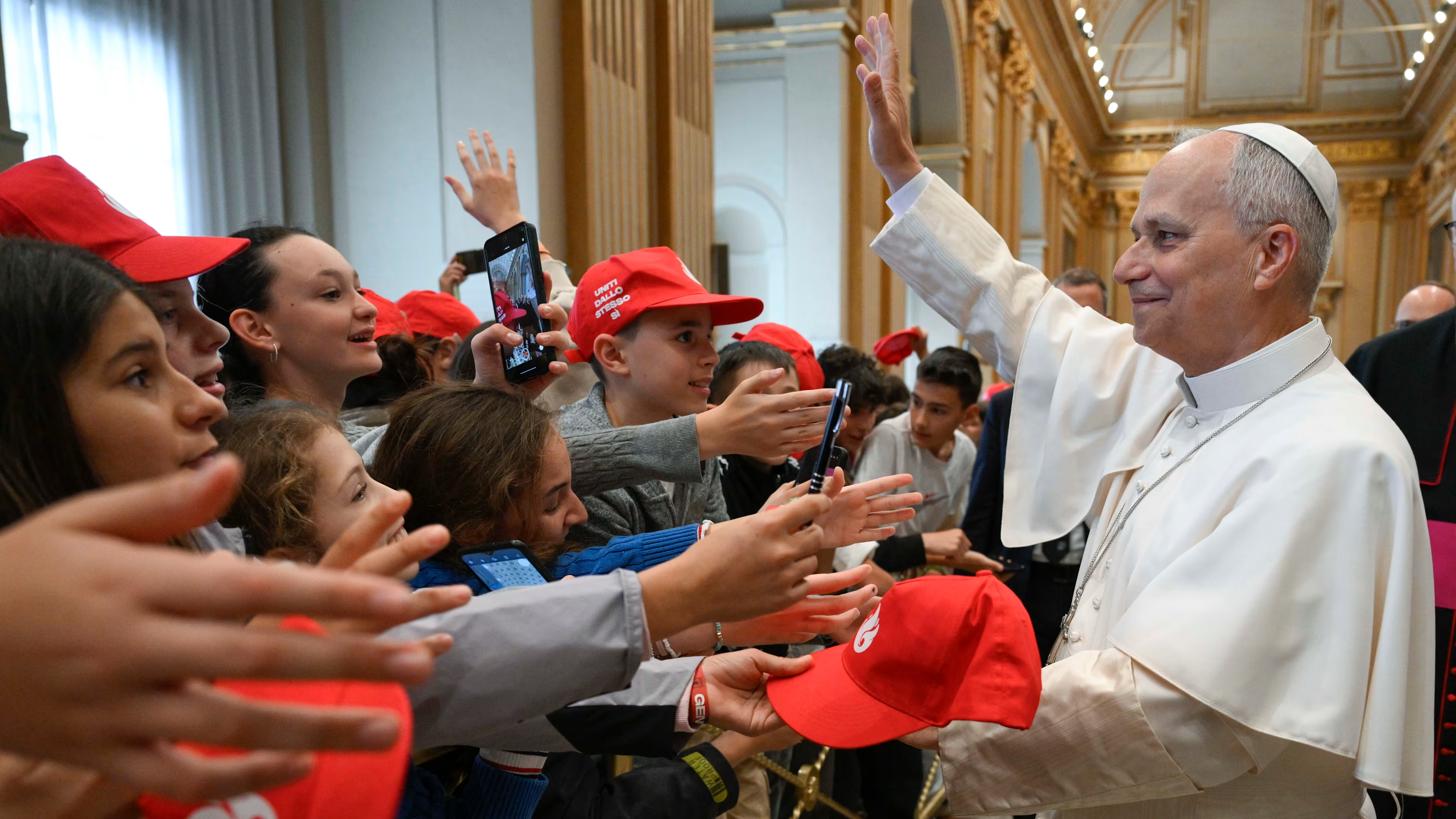
As war continues to scar the world, Pope Leo XIV used his Christmas Urbi et Orbi message to renew his appeal for peace, dialogue, and responsibility, turning to those regions where violence and instability continue to claim innocent lives.
Prayers for peace
The Pope prayed for “justice, peace, and stability for Lebanon, Palestine, Israel, and Syria,” and urged that the promise of peace rooted in righteousness be renewed. He appealed in a particular way for Ukraine, asking that “the clamor of weapons cease,” and that all those involved, with the support of the international community, find the courage to engage in “sincere, direct, and respectful dialogue.”
Remembering conflicts that risk being forgotten, Pope Leo XIV expressed closeness to the victims of war and violence in Sudan, South Sudan, Mali, Burkina Faso, and the Democratic Republic of Congo, as well as to all those who suffer as a result of injustice, political instability, religious persecution, and terrorism.
The Pope also prayed for Haiti, calling for an end to violence and progress along the path of peace and reconciliation. He also invoked peace for Myanmar, asking that the country be guided towards reconciliation and hope, especially for its younger generations. Turning to Latin America, he encouraged those with political responsibilities to give space to dialogue for the common good, rather than to ideological and partisan divisions.
The Pope also prayed for the restoration of the “ancient friendship” between Thailand and Cambodia, and entrusted to God the peoples of South Asia and Oceania, who have been severely affected by recent natural disasters, calling for renewed commitment to assisting those who suffer.
The true meaning of Christmas
Against this backdrop of conflict, Pope Leo XIV recalled the meaning of Christmas, proclaiming that “today, true peace has come down to us from heaven.” Quoting Saint Leo the Great, he affirmed that “the Lord’s birth is the birth of peace.”
Reflecting on the Nativity, the Pope recalled that Jesus “was born in a stable because there was no room for Him in the inn,” and that the Son of God, “through whom all things were created,” was not welcomed. “Out of love,” the Pope said, Christ “accepted poverty and rejection, identifying Himself with those who are discarded and excluded.”
Already in the birth of Jesus, the Pope noted, “we glimpse the fundamental decision that would guide the entire life of the Son of God… the decision not to leave us under the burden of sin, but to bear it Himself for us.” At the same time, he reminded the faithful that peace also requires human responsibility. Quoting Saint Augustine, he said that “God, who created us without us, will not save us without us,” adding that “responsibility is the sure way to peace.”
Christ is peace because he frees humanity from sin
Christ, the Pope continued, is peace because He frees humanity from sin and “shows us the way to overcome conflicts – all conflicts, whether interpersonal or international.” Without hearts that have been forgiven, he warned, it is impossible to be “men and women of peace or builders of peace.”
Pope Leo XIV recalled that, in becoming man, Jesus “took upon Himself our fragility,” identifying with those who suffer today: with the inhabitants of Gaza, the Yemeni people, refugees and migrants, the unemployed, exploited workers, and prisoners who often live in inhumane conditions. For this reason, he warned against indifference, reminding the world that “God is not indifferent to our distress.”
The door that is always open
As the Jubilee Year draws to a close and the Holy Doors prepare to shut, the Pope offered a final message of hope. “Christ our hope remains with us always,” he said, reminding the faithful that He is “the Door that is always open,” who comes not to condemn but to save.
The Author