
Our sin and the burden of a world that is in flames
By Andrea Tornielli
“How rare it is to find adults who repent—individuals, businesses, and institutions that admit they have done wrong!”
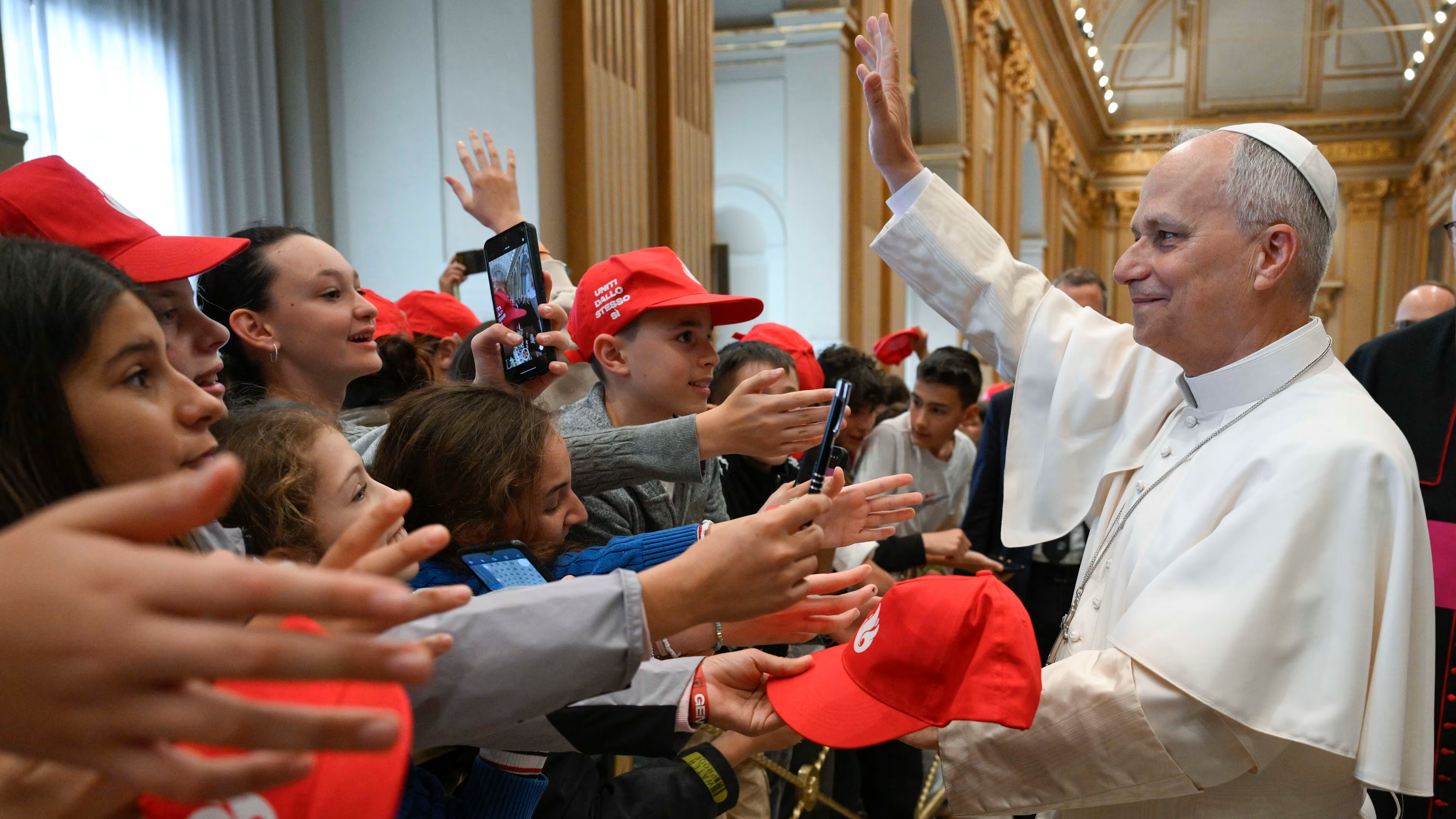
Those words spoken by Pope Leo XIV in his homily at the Ash Wednesday Mass at the Basilica of St. Sabina capture a reality of our time: we live surrounded by people, businesses, and institutions at every level that hardly ever admit they have made a mistake.
We struggle mightily to admit we were wrong and to ask forgiveness by acknowledging our mistake—our mistakes.
The beginning of Lent offers a great opportunity for Christians to recognize ourselves as sinners, in need of help and forgiveness, and it is striking how the Successor of Peter wished to underscore Lent’s communal dimension. “The Church exists as a community of witnesses that recognize their sins,” he said.
Instead of always seeking an external enemy and looking at the world while considering ourselves always in the right and on the right side, we are called to a countercultural attitude and to a “courageous assumption of responsibility,” on that is both personal and collective.
It is true that sin “is personal,” as the Pope emphasized. But it is equally true, he added, echoing the encyclical Sollicitudo rei socialis of Pope St. John Paul II, that it “takes shape in the real and virtual contexts of life, in the attitudes we adopt towards each other that mutually impact us, and often within real economic, cultural, political and even religious ‘structures of sin’.”
Among these, we could include certain aspects of the current economic-financial system, which produces enormous imbalances and injustices, defined by Pope Francis in his first apostolic exhortation as “an economy that kills.” They also include the crushing economic interests that drive the massive arms market, which needs to be fed by permanent conflicts.
Ashes on the head of each person and the community as a whole invite us to feel, Pope Leo XIV said, “the weight of a world that is ablaze, of entire cities destroyed by war.”
“This is also reflected in the ashes of international law and justice among peoples, the ashes of entire ecosystems and harmony among peoples, the ashes of critical thinking and ancient local wisdom, the ashes of that sense of the sacred that dwells in every creature,” he said.
In undertaking the Lenten journey, our shared participation is important, as we grown in awareness that personal sin is amplified and crystallized into “structures of sin.”
As we receive ashes on our heads, we are called to an examination of conscience about our errors, but also about those that reverberate on a large scale.
Therefore, in feeling the burden of a world that is burning, we can ask ourselves—as a community, as a country, as Europe, as international organizations—have we done everything possible to bring to an end the tragic war in Ukraine, which began with the full-scale Russian invasion in 2022? Has everything possible been done to seek negotiated solutions, or is the only true objective pursued today merely that of the mad race to rearm?
How was it possible to witness, after the inhuman attack perpetrated by Hamas against Israelis, the total destruction of Gaza with its more than seventy thousand dead? Why has nothing concrete been done to put an end to the massacre?
How is it possible to accept that there are countries where the free expression of popular protest is stifled in blood with thousands of victims?
And again, how is it possible to accept—for the sake of quiet living or political affiliations—the perpetuation of the hecatomb that takes place in the Mediterranean Sea, with migrants drowning there?
“We recognize our sins so that we can be converted,” concluded the Pope. “This is itself a sign and testimony of Resurrection. Indeed, it means that we will not remain among the ashes, but will rise up and rebuild.”
The Author