House of the Lord | St. Lawrence, Price Hill
by Gail Finke
Origins
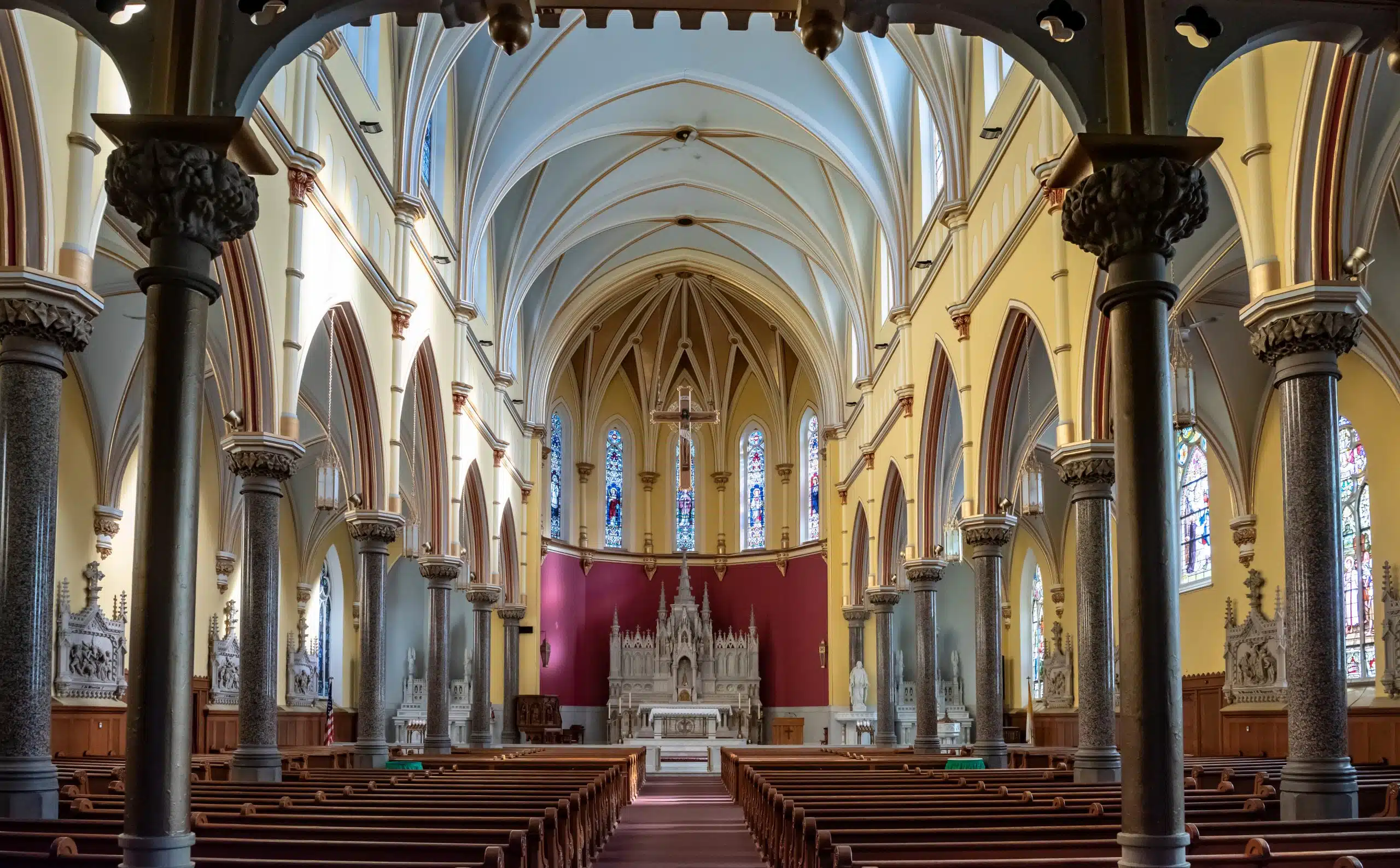
St. Lawrence Church in Price Hill began as a parish for German immigrants, who hired one of the most popular German-born church architects in America to design the immense and elaborate Gothic building. Parishioners worshiped in a basement area they called “the catacombs” while the church was built in stages.
Through the Years
1868
The parish was formed at Mount St. Mary’s Seminary (located then in Price Hill), and its original building opened in 1870 as a combined church and school.
1886
The cornerstone for the current church was laid across the street from the original building. Designed by Adolphus Druiding, the elaborate stone building cost more than $100,000.
1894
The church was finished and dedicated. It features an ornate exterior: a large number and variety of stained and art glass windows, the largest made in 1912 by the Emil Frei Art Glass Company of St. Louis; an elaborate carved high altar made of marble and onyx; marble side chapels and communion rails; a carved and gilded organ loft supported by metal pillars; extensive carved Gothic woodwork; a gilded groined ceiling with carved details; and three towers—the highest reaching to 189 feet.
2022–Present
Recent renovations include a diamond-paned stone floor installed in 2022 and a massive new organ to replace the 1901 organ from G.G. Hook & Hastings, which featured almost 3,000 pipes. Designed to custom specifications from the Rudolf von Beckerath company in Hamburg, the new organ has nearly 3,500 pipes and took more than two months to install in fall 2025. It is the largest pipe organ in the archdiocese.
By the Numbers
3
Towers with spires
2
Massive bells in the bell tower—“Lawrence Joseph” (4,263 lbs.) and “Augustine Mary” (2,250 lbs.)
1
Custom pipe organ, the largest in the archdiocese
Namesake
St. Lawrence was one of seven deacons appointed by Pope Sixtus II, who was executed while saying Mass during Emperor Valerian’s reign. Given three days to bring all the churches’ treasures to the city prefect, Deacon Lawrence instead gave all he could away and told the prefect the Church’s treasures were its poor and crippled. Martyred by being roasted alive on a gridiron, he is famous in legend for telling his executioners, “Turn me over, I’m done on this side!” He’s the patron saint of librarians, cooks—and comedians.
Quote
“The new organ is a North German Baroque Revival, most suited for music of that genre and traditionally-based liturgy and hymnody. But it’s also flexible enough for a wide scope of classical organ music for all periods. It was expanded to accommodate a large choir, which gives it even further flexibility.” –John Valentine, Organist and Director of Music
This article appeared in the March 2026 edition of The Catholic Telegraph Magazine. For your complimentary subscription, click here.
The Author