The Ancient Providers and Protectors of God’s Family
Church Fathers | Father Jacob Lindle
“On the day which is called Sunday we have a common assembly … and the memoirs of the Apostles or the writings of the Prophets are read. … Then, when the reader has finished, the president of the assembly verbally admonishes and invites all to imitate such examples of virtue. Then we all stand up together and offer up our prayers, and … bread and wine and water are presented. He who presides likewise offers up prayers and thanksgivings (‘eucharistias’) … and the people express their approval by saying ‘Amen.’ The Eucharist is distributed and consumed by those present, and to those who are absent, it is sent through the deacons. The wealthy, if they wish, contribute whatever they desire, and the collection is placed in the custody of the presider. With it … he takes care of all those in need” (First Apology, 67).
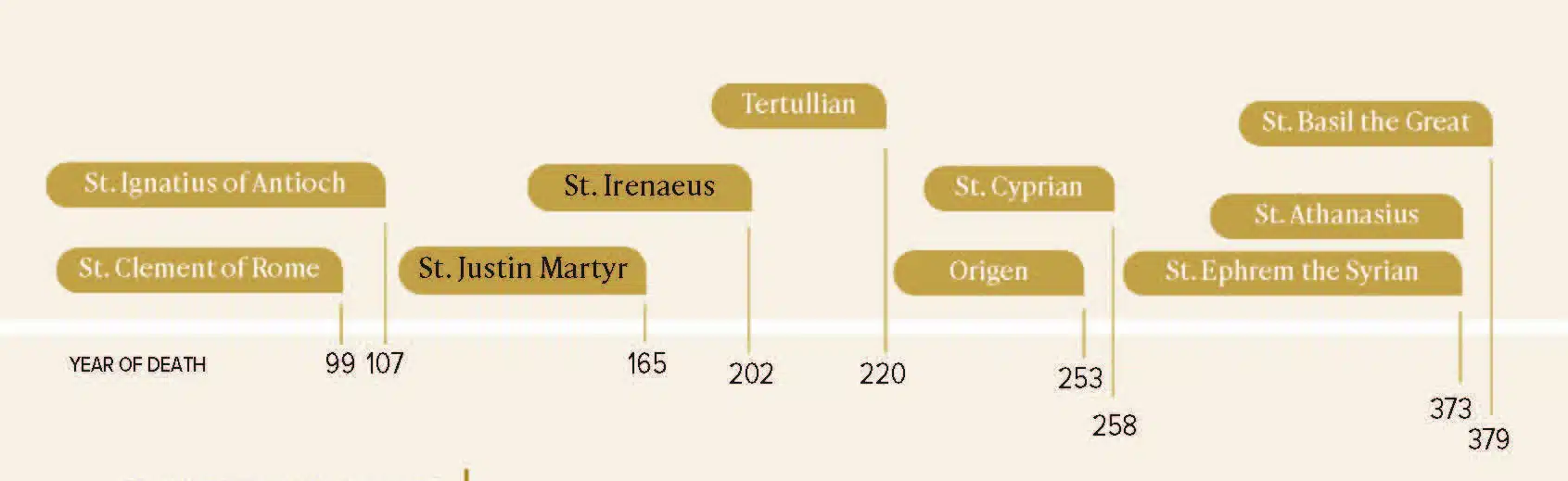
That was written in A.D. 150 by a pagan philosopher named Justin, who converted to Christianity and later died for the faith. Now 1,876 years later, we still do every Sunday what he wrote above: Liturgy of the Word, Liturgy of the Eucharist, the homily, the great Amen, the collection! And in case you had any doubts, Justin also lets us know that the Eucharist is really “the flesh and blood of Jesus who was made flesh” (66).
Justin Martyr is what we call an “apologist,” a defender of the faith. We have this account of the Mass because Justin was writing to the Roman emperor to set false rumors straight: the early Christians weren’t cannibals, as some people claimed, but they did mystically partake in the flesh and blood of Christ.
Justin not only defended Christianity against rumors, he also presented, in full intellectual force, the Gospel as the fulfillment of all Old Testament prophecies and the fulfillment of the stirrings for God in each restless human heart. In his great defense of the faith, Justin is the first writer to develop two key points in Catholic theology: Mary is the New Eve (Dialogue with Trypho, 100) and the destiny of human persons is “to become gods” (124).
What is hinted at in Justin, though, becomes beautifully elaborated in the Church’s first theologian. Writing around 180 in France, St. Irenaeus still breathed the air of the Apostles: he was a disciple of St. Polycarp who was a disciple of St. John, and he saw it as his mission to defend the apostolic faith against the threat of Gnosticism.
The Gnostics were comprised of various esoteric groups who claimed to know what Jesus really taught rather than what the Catholic Church and her bishops claimed He taught. Essentially, the Gnostics denied both the goodness of creation and the reality of the Incarnation. In his systematic, elbow-to-the-face takedown of Gnosticism, Irenaeus became the first theologian to thoroughly develop and draw out rich implications of the apostolic faith.
Perhaps the most striking example of Irenaeus’s theological depth comes from his meditation on Mary. If we carefully studied Luke 1 (or John 2 and 19 or Revelation 12), we would find that Scripture has a whole lot to say about Mary. Irenaeus is the first writer to substantially unpack the mysteries which Scripture itself contains and which Tradition faithfully passed down.
Irenaeus makes explicit what Scripture tells us implicitly: just as Christ is the New Adam (Romans 5, 1 Corinthians 15), Mary is the New Eve. Listen to how clearly he puts it: “the knot of Eve’s disobedience was untied by Mary’s obedience. What Eve bound through her unbelief, Mary loosed by her faith” (Against the Heresies, III, 22, 4) .
Speaking of the mysteries of Scripture, what does it mean when Psalm 81 says, “You are gods?” Jesus Himself mentions the verse in John 10, and Justin says that, somehow, this is the hope of Christians. Irenaeus dives deep to draw out the significance of what later writers will call “divinization.”
Obviously, we humans can’t become God as God is God, because we are created and finite beings whereas God is uncreated and infinite. On our own, we are mortal and perishable. If we had union with God, though, we could share and participate in His immortality and imperishability and thus become godlike.
This is precisely how Irenaeus explains the Incarnation: “For the Word of God became man, and He who is God’s Son became the Son of man to this end, that man, having been united with the Word of God and receiving adoption, might become a son of God” (Against the Heresies, III, 19, 1).
I feel almost sinful for writing so little about these two key Fathers, but I hope this, at least, is clear: the story of salvation is superabundantly glorious, and it is your story.
Scripture is the inexhaustible and inspired record of its promise, and Tradition is its unfailing messenger. As Justin and Irenaeus show us, moreover, this story is not just a fact; it is also an invitation. What Jesus did in His Incarnation and what Mary lived, with a singular grace, is also extended to you, especially through the liturgy: become the son or daughter of God that you were baptized to be.
For further reading
Saint Justin Martyr, The Fathers of the Church, vol. 6 (Catholic University of America Press, 1969)
St. Irenaeus of Lyons, On the Apostolic Preaching, Popular Patristics Series, (St. Vladimir’s Seminary Press, 2003)
Andrew Hofer, OP, Divinization: Becoming Icons of Christ through the Liturgy (Hillenbrand Books, 2015)
Luigi Gambero, Mary and the Fathers of the Church (Ignatius Press, 1999)
Brant Pitre, Jesus and the Jewish Roots of Mary (Image, 2018)
 Fr. Jacob Lindle was ordained a priest for the Archdiocese of Cincinnati in May 2022. He is presently studying for a Doctorate in Patristic Theology at the Pontifical Gregorian University in Rome.
This article appeared in the March 2026 edition of The Catholic Telegraph Magazine. For your complimentary subscription, click here.
The Author