





The Purity and Martyrdom of St. Maximillian Kolbe
Introducing Luminous Lives: Stories of the Saints

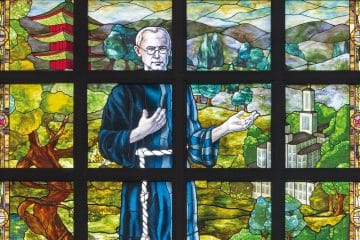
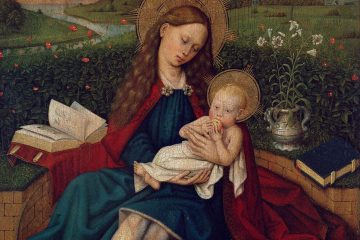
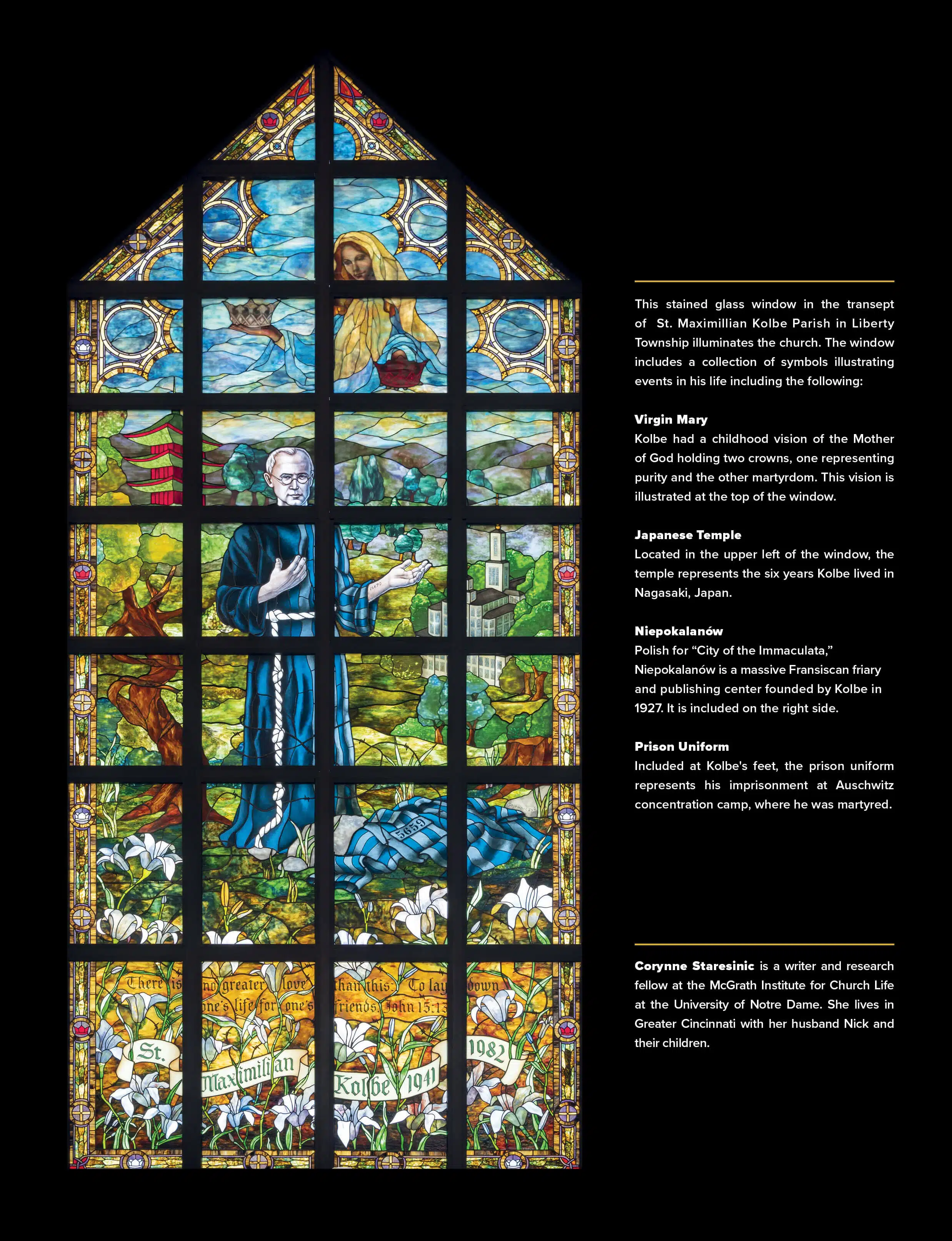
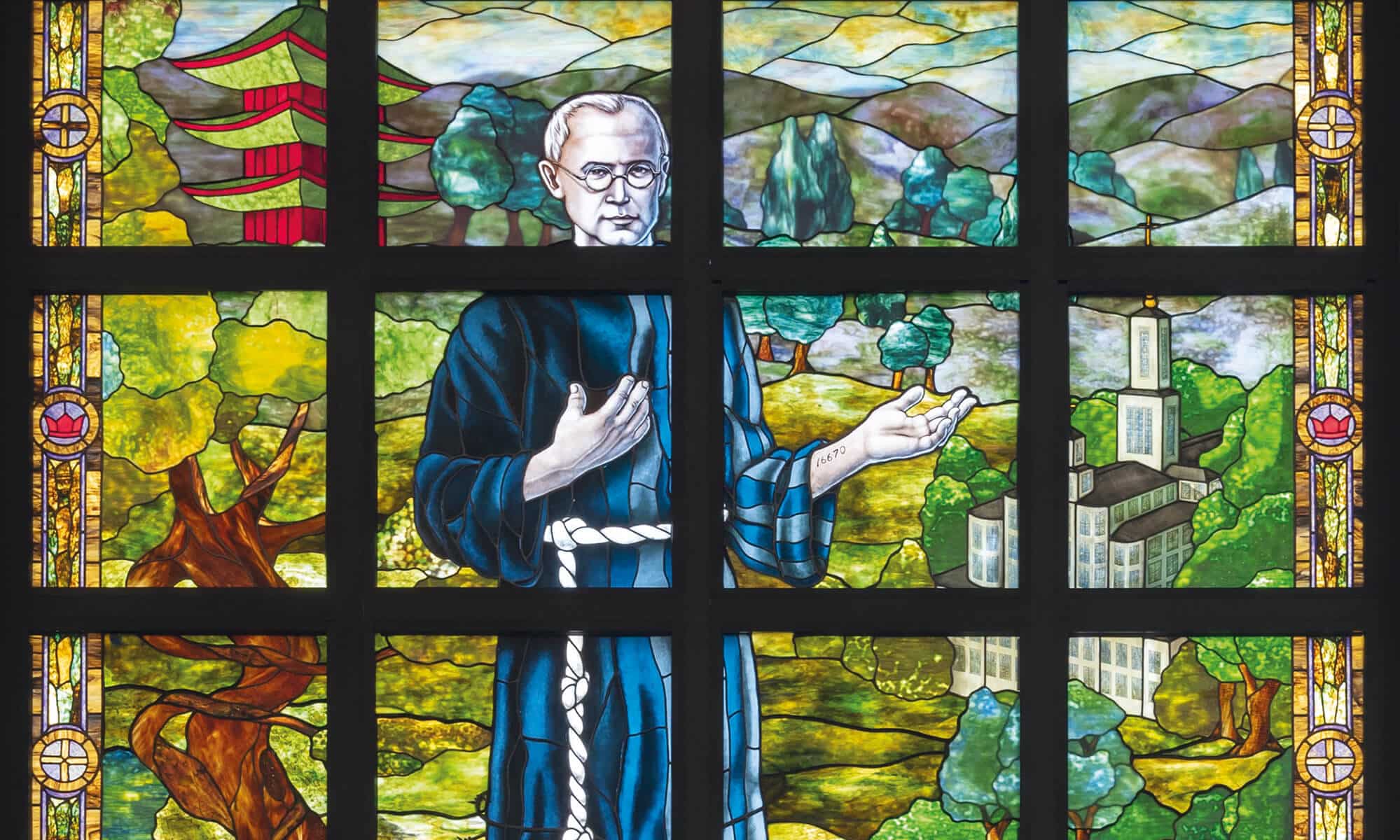 On most Sundays at St. Maximillian Kolbe Parish, my family sits facing a stained glass window of Fr. Kolbe. The window contains a constellation of symbols representing the events of his life; from well-known facts (his Auschwitz uniform) to those lesser known (his time in Nagasaki). At the top of the frame is an image of Mary, inspired by Kolbe’s childhood vision of her. When he was a boy, he saw the Mother of God holding two crowns before him, one representing purity and the other martyrdom. The window is fittingly framed with these crowns, for they became the defining framework for his life.
I often think of how shortly before Kolbe saw Mary, his mother had reprimanded him. He did something objectionable, and she said to him in exasperation, “I don’t know what will become of you!” Soon thereafter, Kolbe received the mystical vision, as if in response to his mother’s implicit question.
That question—“what will become of you?”—is one we all ask of ourselves. When I sit in Mass before that window, sometimes with my boisterous kids, other times with frustration at my sinfulness, and often with distress at the state of the world, his mother’s exasperation resounds in my heart. What will become of you, of myself, of those I love, of humanity? What will become of us?
Theologian Hans Urs Von Balthasar wrote that the life of a saint “is an expression of the Gospel teaching whose kernel is found in the unity of truth and life” (Balthasar, Thérèse of Lisieux: The Story of a Mission, 167). The saints bear in their being the image of Jesus Christ in a diverse array. Startlingly, this life of grace that begot the depths of divine wisdom in the African-Italian saint, Benedict the Moor, the unwavering sincerity of the teenage saint, Bernadette of Soubirous before the mocking crowd, and the sober courage of Kolbe to die in the place of another is in fact the same life to which we are all invited.
Balthasar’s colleague and friend, theologian Louis Bouyer, wrote that we misunderstand the communion of the saints if they remain for us only distant isolated wonders (Bouyer, Christian Initiation, 48). What characterizes the saint before anything else is not the lofty heights of mysticism (if present), their magnanimity, or their piety but as Bouyer wrote: the charity of Jesus Christ, which “is spontaneous, gratuitous and unselfish,” offered for all, even for the most wicked and even unto death (Christian Initiation, 46).
This charity is made present in each saint uniquely, but it comes from the same source. The communion of saints then, as Bouyer wrote, is really a “testimony to the continuous living presence of the Word of God in God’s people, the Church” (Christian Initiation, 48). Bouyer gives a lovely analogy: like flowers blooming on a tree, the saints reveal “in dazzling colors” God’s love which “flows everywhere beneath the bark” of the tree of the Church like sap (48). The communion of saints is thus not “an exclusive spiritual club, to be respectfully bowed to from a distance, but a brotherhood open to all, which all are invited to join” in the life of the Church (48).
When the sun flickers in through that window at our parish, the illustration of Kolbe’s life is activated and lights up the Church. The same grace shining through his life in dazzling colors to us today—like a flower blooming from an old tree or sunlight streaming through stained glass—is the same grace offered to each of us by the God who loves humanity even unto death. Our lives are like dormant buds and unlit naves. Though Kolbe’s mother did not know it, her exasperated question brimmed with hope. The answer to her question as it pertains to us then lies in our willingness to let the light in as our brothers and sisters, the saints, did.
This column marks the beginning of a new series on the saints called Luminous Lives. Each month we will explore the witness of a saint, bringing into focus some defining moments in her or his life. Together, we will trace the thread of divine grace binding the saint to God—the same thread that is still extended and offered to each of us by Him, today.
The Author

