
The Sacred Heart of Jesus on the Air
A Closer Look at Dr. Craycraft's New Role as Host of Driving Home the Faith
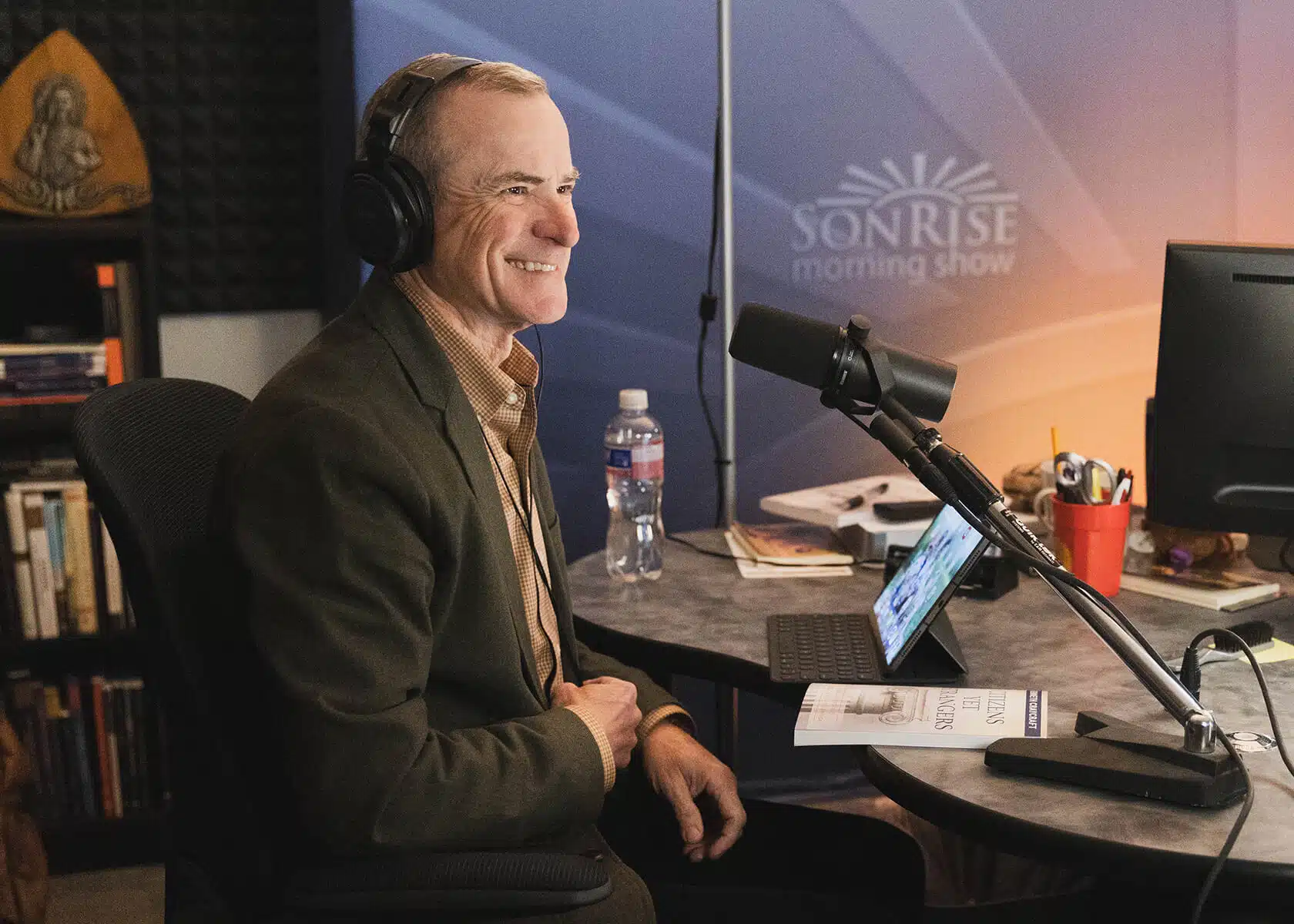 As most readers of this column are aware, my primary job is Professor of Moral Theology at Mount St. Mary’s Seminary and School of Theology. Some of you might know that I am also an attorney, licensed in Ohio and many federal courts. But for the past five months or so, I have added a new job to my resume. The month of June, dedicated to the Sacred Heart of Jesus, is as good a time as any to talk about my new gig as the new host of the afternoon radio show Driving Home the Faith on Sacred Heart Radio.
Of course, an account of my position as host of Driving Home the Faith cannot begin without a tribute to Fr. Rob Jack, who hosted the show for about 8 years prior to his sudden, untimely death last October. Fr. Rob was one of the first priests I knew when my family moved to the area in 2001. While teaching at Mount St. Mary’s, Fr. Rob was on the regular rotation of visiting priests at my parish. Who could forget this humble, prayerful man, with his plain-spoken but powerful homilies about the moral and spiritual life? And, of course, he always had his rosary CDs stacked at the exits for people to take after Mass. How many Catholics in the Archdiocese of Cincinnati still say the rosary with Fr. Rob from these CDs? He was beloved as the host of Driving Home the Faith. I can neither replace Fr. Rob nor replicate the program as he hosted it. Nor shall I try. He was one-of-a-kind, and we all miss him terribly.
Some of Fr. Rob’s regular guests on the show have continued to appear since I took over the microphone in January—if it ain’t broke, don’t fix it! On the other hand, I am steering the show in a slightly different direction, at least in terms of dominant themes and interests. Specifically, three principles direct my choice of guests and themes for Driving Home the Faith.
First, I am guided by a strong theology of the goodness of creation, which means the goodness of all things. In St. Augustine’s great spiritual memoir, The Confessions, he wrestled mightily with the problem of the “existence” of evil in the world. His journey toward Christian faith took him through a philosophical school of thought called “Manichaeism.” This philosophy taught that evil and good are two independent realities in the world, the former characterized by matter and the latter by spirit. But, thought Augustine, if evil has its own existence, it must have been created by God. This conflicted with his growing conviction that God is all good and that He is the creator of all things. How can an all-good God create evil? And yet, we see “evil” all around us. Augustine’s solution is that “evil” does not have its own existence, but rather is the lack of perfection, or the privation of good. This means that all things as created are good but fallen. The goal, then, is not to eliminate evil, but rather to embrace, celebrate, and propagate the good—to love the evil away. This also implies that, in their essence, all things are good.
This leads to the second major impulse of my intentions for Driving Home the Faith. Because all things are good as created by God, all things are capable of communicating to varying degrees the love and grace of God. Ours is an incarnational faith, which means that grace is communicated through material things. God is present in all things, and thus all things can communicate God’s love. As Georges Bernanos’ protagonist priest in Diary of a Country Priest declares, “Everything is grace.” With this in mind, Driving Home the Faith will feature guests and themes who represent goodness, even if the topic is not expressly “Catholic.” If it’s good, it’s from God and, therefore, can contribute to human flourishing. Toward that end, I will continue increasing the number and frequency of guests who represent goodness in art, music, literature, and sport, as well as in prayer, liturgy, and sacraments.
And this leads to the third animating theme of Driving Home the Faith. Catholicism is a faith of “both/and” rather than “either/or.” Our faith is full of paradoxes and tensions. But those are a feature of our faith, not a bug. Indeed, we have official celebrations of some of these paradoxes. We both feast and fast. We believe in both justice and mercy; in both law and grace; in both faith and works. We celebrate celibacy and fecundity, work and leisure, solitude and community, giving and receiving. We believe in the authority of the Church and the freedom of conscience; of the redemptive nature of suffering and the rejuvenating power of joy; of the solemnity of the sacred and the celebration of the secular.
As June is the month of the Sacred Heart of Jesus and the Immaculate Heart of Mary, Driving Home the Faith will continue its goal of representing the mission of Sacred Heart Radio and try to communicate—as best as I am able—the overwhelming grace and mercy flowing from those Hearts.
The Author