

The Madonna of Humility
Contemplating God’s bottomless love for us is the antidote to counteract the prowling devil’s poisonous pride scheme.
A Guide to Visio Divina
Invite the Holy Spirit to enlighten your experience as you gaze at the painting. Notice what thoughts and emotions enter your heart and mind. Be still. Pray with the image as you are led.
BACKGROUND
From the seat opposite me in the confessional, the priest said, “For your penance, look up Ephesians 3:18-19 and contemplate God’s love for you.”
“And I pray that you … grasp how wide and long and high and deep is the love of Christ, and to know this love that surpasses knowledge.”
The sin I confessed? Pride. C. S. Lewis wrote, “It is pride which has been the chief cause of misery in every nation and every family since the world began” (Mere Christianity, 109).
Pride was the serpent’s tool to entice our first parents in the Garden of Eden in Genesis 3. The devil undermined God’s authority, planting doubt in Eve about God’s truthfulness and reliability. In a few cunning phrases, the “proud spirit” enticed Eve to “Edge God Out,” and the ego took over. The desire to become God-like overcame Adam and Eve in that catastrophic fall, plunging the human race into spiritual ruin. The desire to exalt oneself, the appeal of autonomy, took root in that garden. The devil must have thought, “That was easy.” And he has used that tool continually down through the ages. As Lewis wrote, “It was through pride that the devil became the devil: Pride leads to every other vice: it is the complete anti-God state of mind” (Mere Christianity, 109, 111).
The virtue opposite of pride is humility; thus, the Madonna of Humility became a popular Madonna theme in the 14th and 15th centuries across Europe. There are countless examples of this Madonna-type, distinguished by Mary’s lowly position, seated on the ground as she cradles the Christ Child. But the greatest example of humility in history is the Incarnation of Jesus, the enormously humble act of God becoming a human. The Incarnation was made possible through Mary, the “New Eve” when she said yes to God’s request to be the mother of the Savior. Mary’s yes supplanted Eve’s no.
ENTER IN
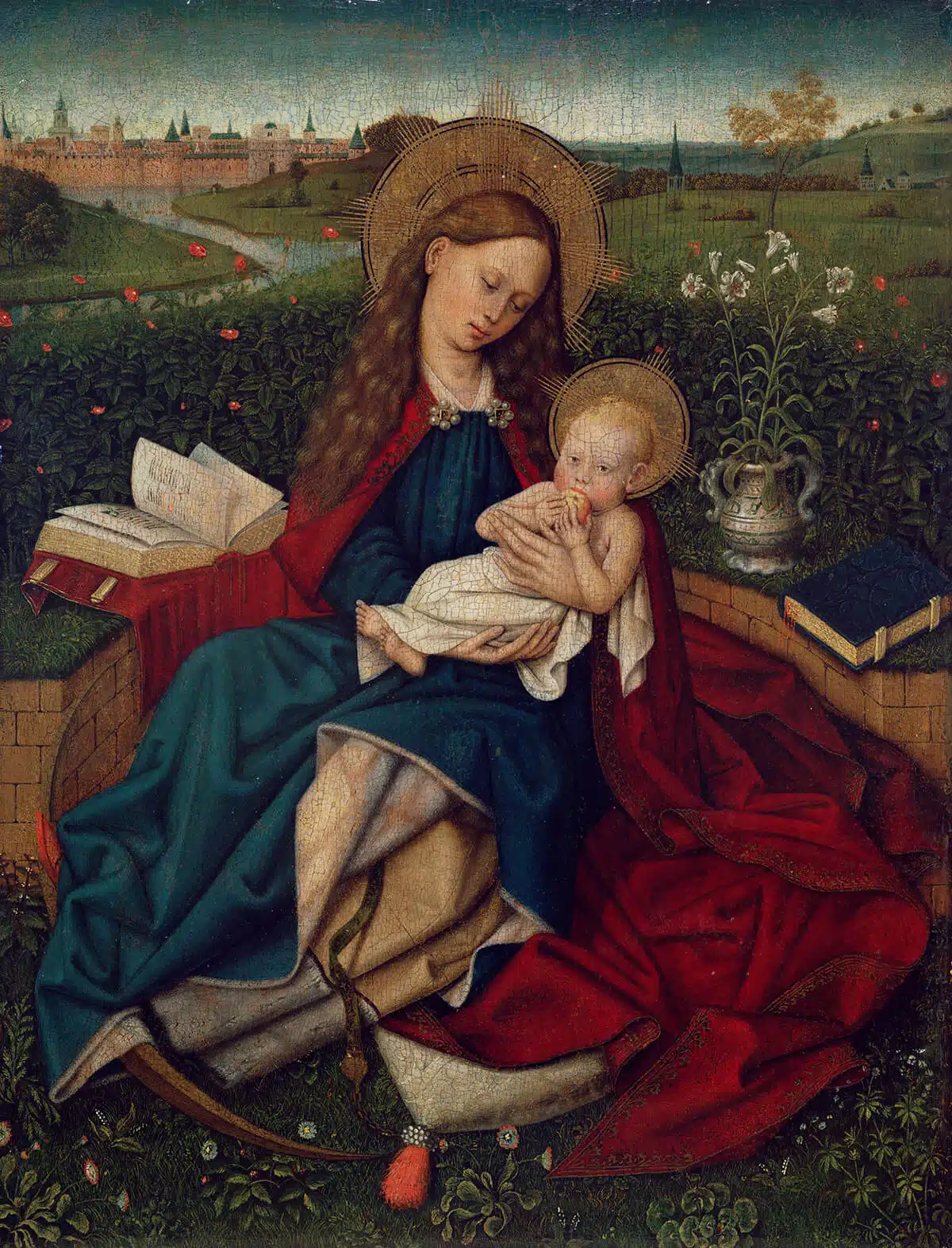
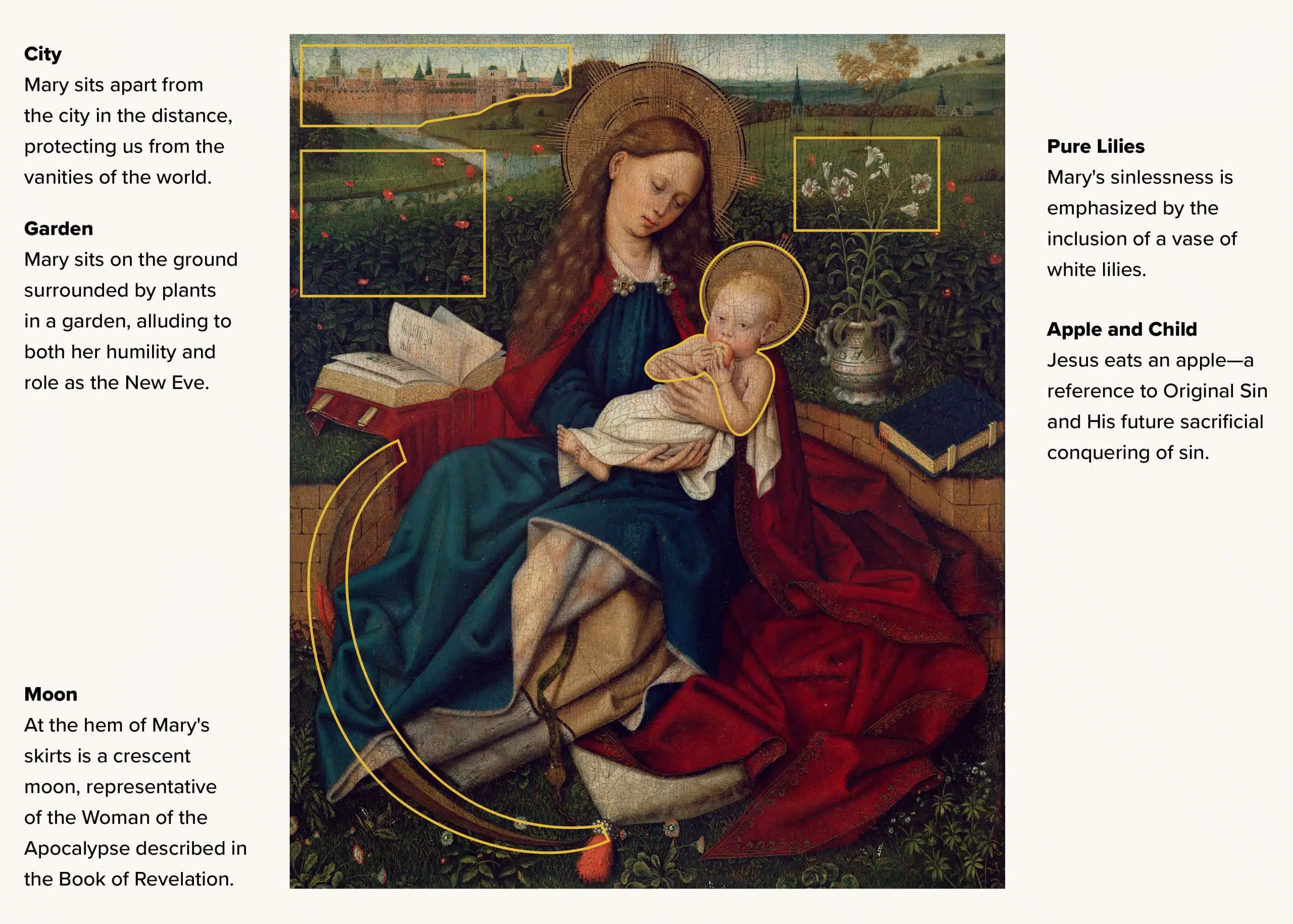
In our Madonna painting from the Getty Museum by an unnamed follower of Robert Campin, Mary sits on the ground in a garden, surrounded by symbols of her role as the New Eve. On her lap, Jesus eats an apple—a reference to Original Sin and His future sacrificial conquering of sin. The open and closed books symbolize the Old and New Testaments. Mary’s sinlessness is emphasized by the white lilies. Being seated on the ground is a reference to Adam, as Adamah is the Hebrew word for ground, soil, earth—used in biblical language to indicate the earth as a source of life: “Then the Lord God formed a man from the dust of the ground” (Gn 2:7).
In this Netherlandish painting, Mary sits in a niche, walled off and apart from the city in the distance, protecting us from our propensity to grasp at the vanities of the world. At the hem of her skirts is a crescent moon, representative of the Woman of the Apocalypse described in the Book of Revelation: “A woman clothed with the sun, with a moon under her feet” (Rev 12:1).
The paradox of a gentle mother cradling her baby and the powerful woman of the Apocalypse is precisely what Mary embodies. Her humility gives her strength.
REFLECTION
St. Augustine wrote that Mary’s humility was a requisite for being the Mother of the Incarnate Son of God: “Mary’s humility certainly became the Heavenly ladder by which God descended to earth” (quoted by Meiss in “The Madonna of Humility,” The Art Bulletin 18, 461). And she exemplifies tremendous humility when the Holy Spirit fills her kinswoman Elizabeth to recognize that Mary is carrying the Savior and Mary responds:
“My soul proclaims the greatness of the Lord; my spirit rejoices in God my Savior. For He has looked upon His handmaid’s lowliness; behold, from now on all ages will call me blessed. The Mighty One has done great things for me, and holy is His name. His mercy is from age to age for those who fear him.”—Luke 1: 46–50
This gorgeous poetry is part of Mary’s longest speech in Scripture, and it is remarkably telling. By giving all the glory to God, by emptying herself and surrendering to God’s will, Mary becomes the Queen of Heaven and Earth.
The Incarnation and Mary’s role in it are wrapped in love.
“For God so loved the world that He gave his only Son so that everyone who believes in Him might not perish but might have eternal life.”—John 3:16
Contemplating God’s bottomless love for us is the antidote to counteract the prowling devil’s poisonous pride scheme. That is what Father had in mind as he sent me from the confessional. God’s love surpasses the hollowness of self-love every time.
For Further Exploration
C.S. Lewis, Mere Christianity. New York: Simon & Schuster Touchstone edition, 1996.
Millard Meiss, “The Madonna of Humility,” The Art Bulletin 18, no. 4. (December 1936): 435-465.
Thomas A. Tarrants, III, D. Min., “Pride and Humility,” Knowing & Doing. (Winter, 2011): 1-6.
The Author