


The Ancient Providers and Protectors of God’s Family
Church Fathers Series: Part 6
Then God said, “Let us make man in our image, after our likeness…” So God created man in his own image, in the image of God he created him; male and female he created them
(Gn 1:26-27).
What does it mean to be made in the image of the God who speaks in the first-person plural? Why does God say, “Let us make man in our image, after our likeness”? For a long time, the answer wasn’t clear. Other religions claimed that there were many gods, but that can’t be: there is only one God. Day after day, Israel was told, The Lord our God is one Lord (Dt 6:4). We’ll have to wait to see the entire answer to our question, but one thing is clear: if we are made in the image of that one God, we are called to show forth the unity of this God to the world.
A quick look at human history, however, shows that we haven’t done such a good job. Sin, death, and division have marked our lives ever since the Garden. What’s the solution to this predicament? Should we try to gather ourselves together to show that we can be united as God? Well, no. We tried that first in a little town called Babel, and things didn’t go so well (see Genesis 11). If we try to achieve unity on our own, we end up with more division.
So, how does God bring unity? First, God gathered a family named Israel, and in the fullness of time, God opened this family to all, in the Church. Unlike the confusion of Babel, the Church born at Pentecost offers a God-given, definitive bond of unity to the world (Acts 2:1-12). We who have been born into the brokenness of Adam’s family must be reborn into the unity of God’s family. How are we reborn? Jesus told us right before He ascended (Mt 28:19), and Peter echoed his Lord on Pentecost (Acts 2:38): we must be baptized in the name of the Father, and of the Son, and of the Holy Spirit. And here, we finally have our answer to the God who speaks in the plural. We are made in the image of the One Who is Three.
Sadly, not everyone baptized into God’s family has lived out this unity. As we saw last month, Arius caused serious division in the Church when he taught that the Son was created. Bishops met at the Council of Nicaea in 325 to reunite God’s family in the true faith, and Athanasius spent the rest of his days fighting for the eternal union of Father and Son.
Unfortunately, the division continued, and throughout the fourth century, many bishops and imperial leaders tried to achieve peace on their own through compromised positions. Nicaea was a little radical, they thought: can’t we all just meet in another synod and make everyone happy? But this isn’t how saints think. Saints want unity, but they want the unity that comes from God and in God.
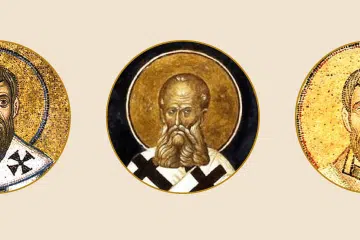
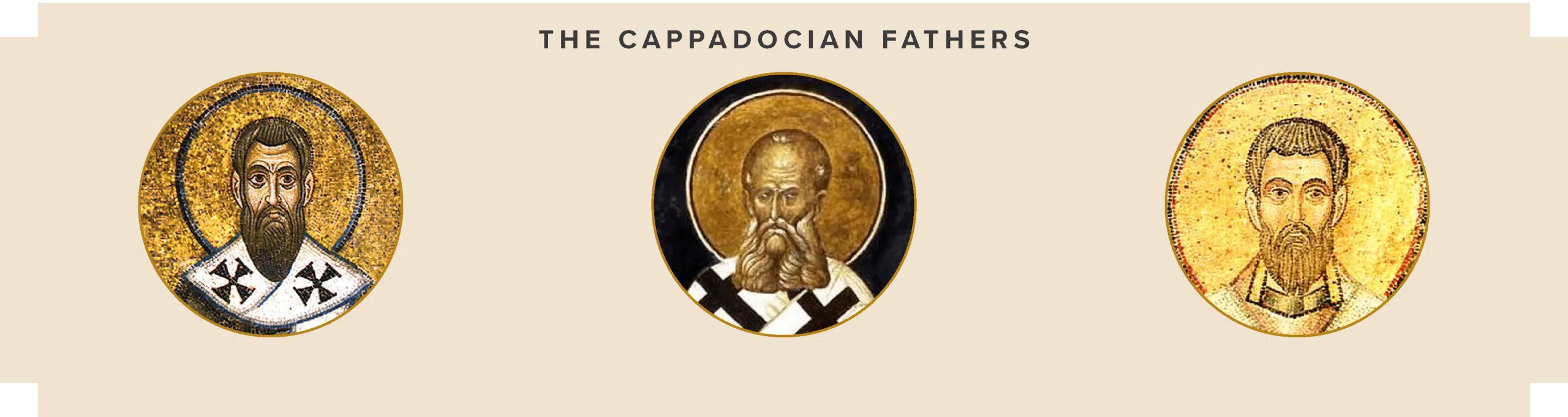
Thanks be to God, many theologians stood up to fight for true unity, and the three which stood tallest were Basil of Caesarea, Gregory Nazianzen, and Gregory of Nyssa. Basil and Nyssa were brothers, and Basil and Nazianzen were best friends. These three men (later called the Cappadocian Fathers) spoke, wrote, and lived the true unity of God.
Basil in particular promoted unity in his heroic dedication to the poor and communal monasticism, but all three were united in their common mission. Against a heretic named Eunomius, who divided God even more harshly than Arius, the Cappadocian Fathers insisted on the fundamental unity of God. Between the Creator and creatures, they insisted, there is an essential divide. The Creator is totally distinct from creatures. Since the Father does not create alone but through the Son and in the Holy Spirit (Let us make man…), the Son and Spirit are not creatures but truly God. These arguments culminated in another family meeting, the Council of Constantinople in 381, which reaffirmed Nicaea’s teaching on the unity of Father and Son and further proclaimed the divinity of the Holy Spirit as the Lord, the Giver of Life, Whom we should adore and glorify.
The Cappadocian Fathers settled on the terms that we will forever use to speak about God: God is one Nature and three Persons. Nature answers the question “what?” and Person answers the question “who?” What is God? One divine Nature—uncreated and perfect. Who is God? Father, Son, and Spirit—three distinct Persons fully sharing the one divine Nature. The Father is neither the Son nor the Spirit, and the Son is not the Spirit; but the Father is fully God, the Son is fully God, and the Spirit is fully God in an ineffable exchange of divine Life, Light, and Love.
Our language fails here, but our inability to grasp is a never-ending invitation into the Mystery. In the beginning, we were made in the image of this triune God. Even after we distorted our likeness, God called us back to communion through baptism, which superabundantly restores the unity that we lost. When we were baptized, we became God’s children, and we became members of God’s family. Now, may we become who we are.

FURTHER READING
St. Basil the Great, On the Holy Spirit (Popular Patristics, St. Vladimir’s Seminary Press, 2011)
St. Gregory Nazianzen, On God and Christ (Popular Patristics, St. Vladimir’s Seminary Press, 2002)
St. Gregory of Nyssa, The Life of Moses (Classics of Western Spirituality, Paulist Press, 1978)
Frank J. Sheed, Theology for Beginners (Angelico Press, 2013)
Lewis Ayres, Nicaea and its Legacy (Oxford University Press, 2006)
Thomas Joseph White, The Trinity (The Catholic University of America Press, 2022)
The Author