
America 250
America’s 250th anniversary offers a moment for us to reflect on how the Catholic Church first took root in Ohio and how fragile those beginnings were. Few in number, the early Catholics of the Northwest Territory and frontier Ohio were scattered across forests, river towns, and isolated settlements, where priests were rare and the sacraments infrequent. Yet they believed deeply in the American promise of freedom to live their faith openly and to pass it on to their children. That dream required both sacrifice and generosity.
In 1808, Jacob Dittoe, a German immigrant who settled near Somerset, Ohio, repeatedly wrote to Bishop John Carroll of Baltimore pleading for a priest to be sent westward. The Dominicans based in Bardstown, Kentucky, sent Fr. Edward Fenwick to minister to the small Catholic community. Through his persistence, St. Joseph Church in Somerset claims the honor of being the first church in the state of Ohio, dedicated on December 6, 1818.
The following year, Catholics in Cincinnati established the city’s first church, on the edge of the settlement in what is now Over-the-Rhine and the present site of St. Francis Seraph. According to Fr. David Endres’ Bicentennial History of the Archdiocese, Christ Church was a rough wooden chapel, inconveniently located in the woods a mile beyond the city, reached by muddy roads that were notoriously difficult to travel in wet weather.
These were the conditions Bishop Edward Fenwick encountered when he arrived in the newly created Diocese of Cincinnati two years later. There was little money, few priests, and almost no institutional foundation. The territory included all of Ohio and Michigan and parts of Wisconsin. He wrote in 1823, “It requires nearly six months to make the visit of my Diocese of Ohio, not allowing myself more than a week or two to spend in each congregation or settlement of Catholicity.”
The situation became so desperate that Fenwick traveled to Rome to resign his office as Bishop. Instead, Pope Leo XII encouraged him to persevere. He travelled throughout Europe seeking help for his fledgling diocese. Catholics across France, Belgium, and Germany responded with remarkable generosity, donating funds, books, vestments, and sacred vessels.
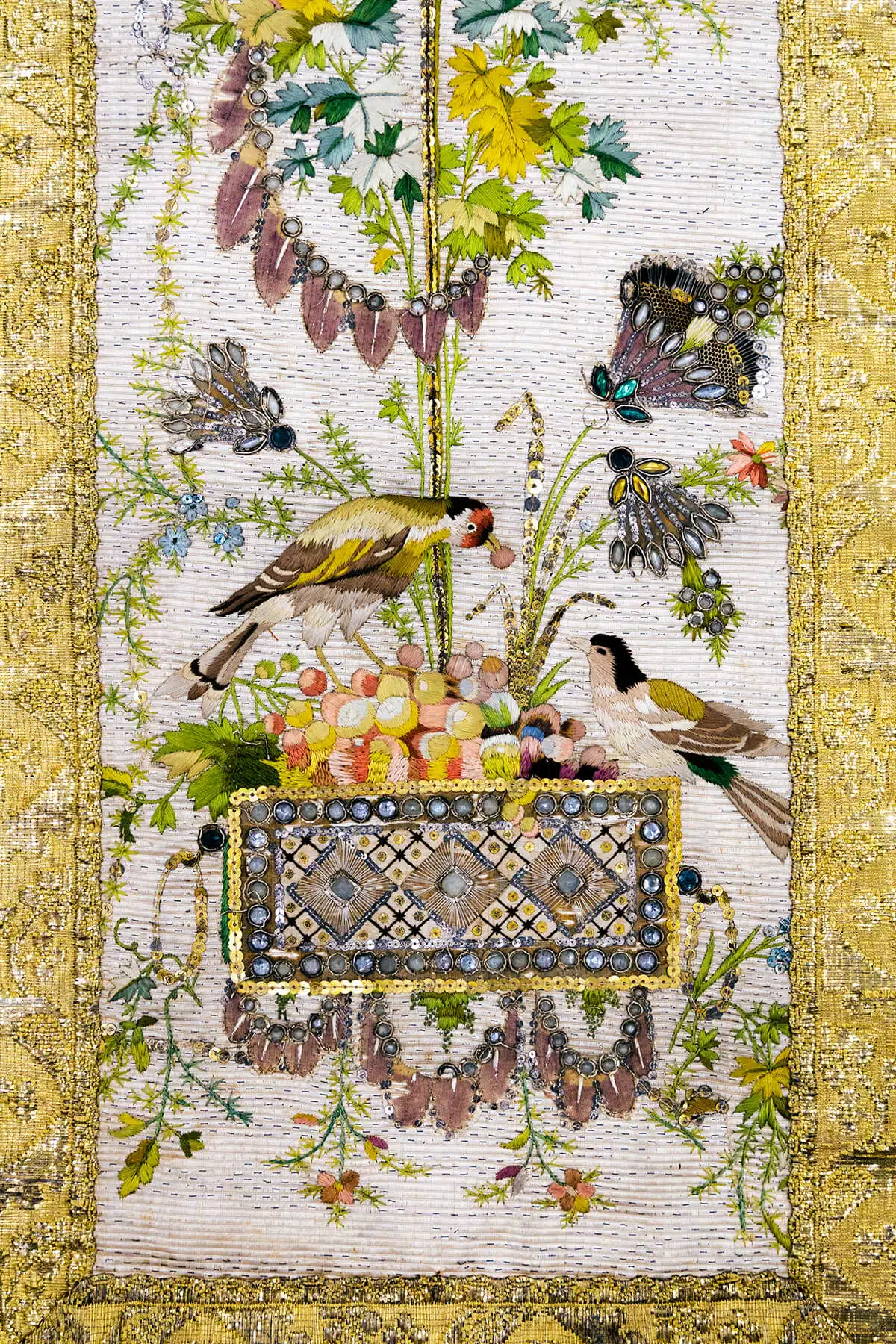
A richly embroidered chasuble associated with Fenwick’s European journey survives here in the archives. Small birds, butterflies, and flowers are stitched across the fabric, as a gold braid edging and wide gold ribbon frame the neckline and central panels. The panels are asymmetrical and not identical in design, suggesting they were salvaged from another decorative cloth. Much like the early Church in Ohio, it bears signs of repair, adaptation, and careful preservation.
Throughout the nineteenth century, millions of Catholic immigrants arrived in the United States, bringing with them devotional practices, languages, and traditions that shaped parish life in Ohio for generations. Priests volunteered for missionary work, and women religious crossed oceans into uncertainty. Over time, small Catholic communities became woven into the fabric of society through schools, hospitals, charitable institutions, and public service.
The archives preserve traces of those lives: letters sent across oceans, vestments carried westward, records of baptisms, marriages, and burials entered carefully by hand. Together, they tell the story of a Church sustained across distance and generations through countless acts of endurance and mutual care. Φ
The Author