
Catholics on the Ohio Frontier
On September 3, 1783, the Treaty of Paris was signed, ending the American Revolutionary War. As part of the treaty, the Ohio Country—the region between Lake Erie and the Appalachian Mountains—was surrendered by Great Britain to the newly independent United States. The treaty also opened the Ohio Valley to settlement and land speculation, leading to the beginning of westward migration.
French Exploration
This frontier region, in addition to the presence of Native American tribes, was the site of French trading posts and small settlements, though most did not remain intact after the French relinquished their claims to the region following the Seven Years’ War (1756–1763). While the British were anti-Catholic, the French brought their Catholic faith with them. The French viewed the land not only as territory to be claimed but as a field for evangelization.
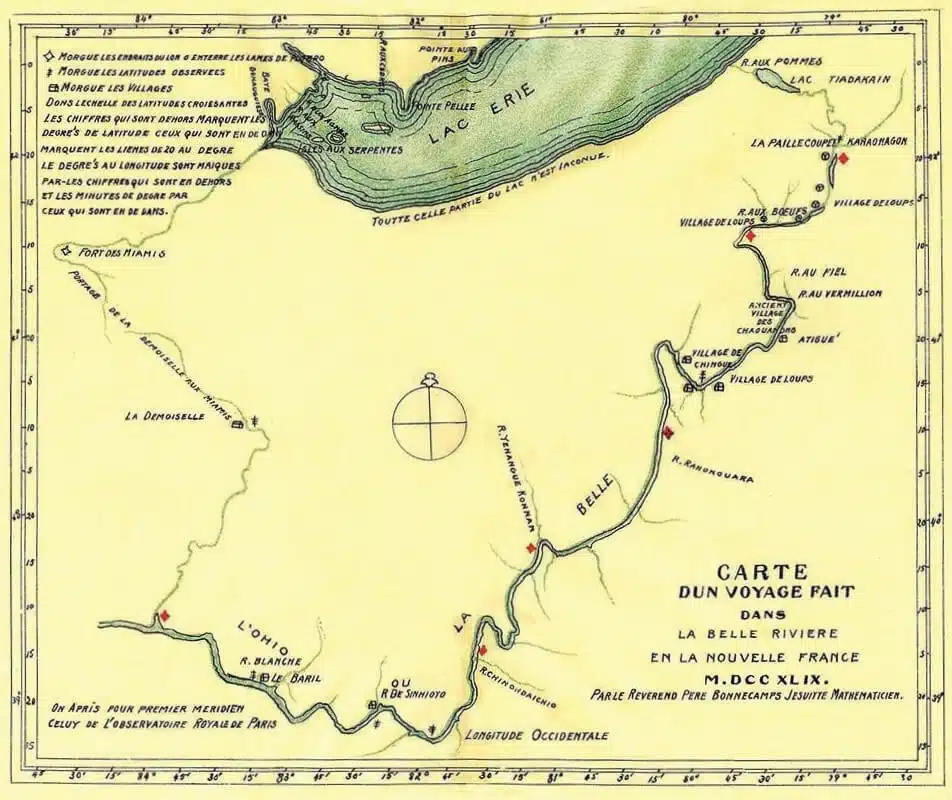
In 1749, Pierre Joseph Céloron de Blainville claimed for the French crown the land that is today Ohio. He came to the area near present-day Piqua with almost 300 men, including Jesuit priest Fr. Joseph-Pierre de Bonnécamps, who likely offered the first Mass in this part of the Ohio Country. An accomplished mathematician and cartographer, the priest kept a record of the expedition, providing an early account (and the first detailed map) of the Ohio region.
Fort Loramie
Beginning about 1769, the French trader Pierre-Louis de Lorimier (Peter Loramie) operated a store near today’s village of Fort Loramie, in Shelby County. Lorimier traded with Native Americans and eventually married a Shawnee woman, but after his trading post was destroyed in 1782 during George Rogers Clark’s anti-Indian campaign, he and his family relocated farther west. The French trading presence in Shelby County ended with Lorimier’s departure, but additional French came to the region in the nineteenth century, forming the communities of Versailles, Frenchtown, and Russia.
Although no Catholic presence from the colonial period survived, a relic of Fort Loramie’s early French influence remains. In 1872, a silver cross, nine inches long by six inches wide, was found near the site of Lorimier’s store. The cross may have been more a form of currency than a sign of religious devotion, but it was interpreted as a sign of the earliest settlers’ Catholic faith.
The Northwest Territory
The Northwest Territory was established in 1787 by the U.S. Congress’s passage of the Northwest Ordinance. The territory encompassed present-day Ohio, Indiana, Illinois, Michigan, Wisconsin, and Minnesota.
It was notable for guaranteeing religious freedom and prohibiting slavery. At a time when some states still had forms of religious establishment (the U.S. Bill of Rights was not ratified until 1791), the Northwest Ordinance declared that no one “shall ever be molested on account of his mode of worship or religious sentiments.” And even more positively, “Religion, morality, and knowledge, being necessary to good government and the happiness of mankind, schools and the means of education shall forever be encouraged.” The promotion of religion and education brought the possibility of Catholic settlement.
Gallipolis
French immigrants associated with the Scioto Land Company established Gallipolis (literally, City of the Gauls, referring to the French) in Gallia County along the Ohio River, in 1790. The settlement encountered difficulties from the start. The immigrants received deeds to land the company did not actually own, and although they believed they had bought cleared land, they found instead a dense wilderness.
The settlement retained its French identity, including Catholic traditions and practices, although with some difficulty. Benedictine priest Pierre-Joseph Didier who had come with the settlers but moved farther west within two years. Thereafter, Gallipolis was sporadically attended to by traveling missionaries. The faithful were largely left to sustain their faith practices on their own—a common condition on the frontier.
Cincinnati
While sporadic settlement continued north of the Ohio River, the site that became Cincinnati was the location of a large military stockade named Fort Washington (built in 1789). Near today’s downtown, the site faced the Licking River in present-day northern Kentucky. The settlement north of the river was originally named Losantiville, a combination of Latin and Greek terms meaning “town opposite the mouth of the Licking.”
Unlike other early settlements that included Catholics, there was no identifiable Catholic presence in Cincinnati prior to 1800. A handful of Catholics from Baltimore and Philadelphia began to settle there around that time, but the first Catholic congregation did not organize in Cincinnati until 1819.
Legacy
Today, there are few traces of Ohio’s frontier Catholics. They left no formal institutions—no parishes, schools, or charitable organizations—but they did contribute to the larger story of keeping faith alive amid adversity. It largely fell to the settlers and immigrants who came after 1800 to establish the Catholic Church’s presence in Ohio, but they did so according to the pattern of those who came before.
How Cincinnati Got Its Name
The city of Cincinnati was originally founded in 1788 as “Losantiville.”
Territorial governor, Arthur St. Clair, renamed the settlement “Cincinnati” In 1790 to honor the Society of the Cincinnati, which was formed by officers who had served in the American Revolution and was named after the Roman statesman Lucius Quinctius Cincinnatus, who was famous as a symbol of civic virtue.
According to Roman tradition, Cincinnatus left his farm to lead Rome during a crisis, then voluntarily gave up power and returned to private life once the danger had passed. America’s Revolutionary officers admired that example of service without personal ambition.
One of the Society’s most prominent members was George Washington, who served as the organization’s first president-general.
George Washington earned the nickname “American Cincinnatus” after he took up military command during a national crisis and, upon victory, voluntarily surrendered absolute power to return to his private life as a farmer.
The Author