
Patriot Catholics
How did Catholics in the colonies respond to the Revolutionary War?
Q: How did Catholics in the colonies respond to the Revolutionary War? Did they back the revolution or the British crown?
Before the U.S. Revolution, Catholics were a small minority in the Thirteen Colonies (perhaps only one to two percent of their population). They suffered under both anti-Catholic measures and popular persecution. Even in Maryland where they were the most numerous, Catholics could not worship publicly, become teachers or lawyers, or be elected to political office. In many colonies, the Church of England became the official Church, and Catholics were taxed to support it.
As members of a minority, Catholics had a vested interest in the colonies’ future. The Revolution provided Catholics an opportunity to help chart that future, including the possibility of a new nation that assured their freedom of worship.
Antagonism in England
England was a difficult place for Catholics. In breaking from the Catholic Church in the 1530s, King Henry VIII took most of his subjects with him. Under Henry and his eventual successor, Queen Elizabeth, laws were enacted against those who refused to renounce Catholicism. Catholics were imprisoned and had their properties confiscated. Priests found it necessary to carry on their ministry in disguise and in secret. Many Catholics dreamed of a land where they could worship God in the old way.
In 1633, some Catholic colonists left England aboard two ships, the Ark and the Dove. The Ark halted off the Isle of Wight to take aboard two Jesuit priests (anti-Catholic laws did not permit them to sail from England). The colonists landed a few months later on the Potomac River island of Saint Clement, just off the Maryland shore, and began a settlement.
The Revolution
Despite continued persecution under British colonial rule, Catholics managed to thrive in Maryland, becoming some of the colony’s richest families. Their manor houses became centers where the faith was practiced privately. Visiting priests said Mass, taught catechism to children, and administered the sacraments. One of these wealthy families was the Carrolls. No Catholic family played a greater role in the foundation of the United States.
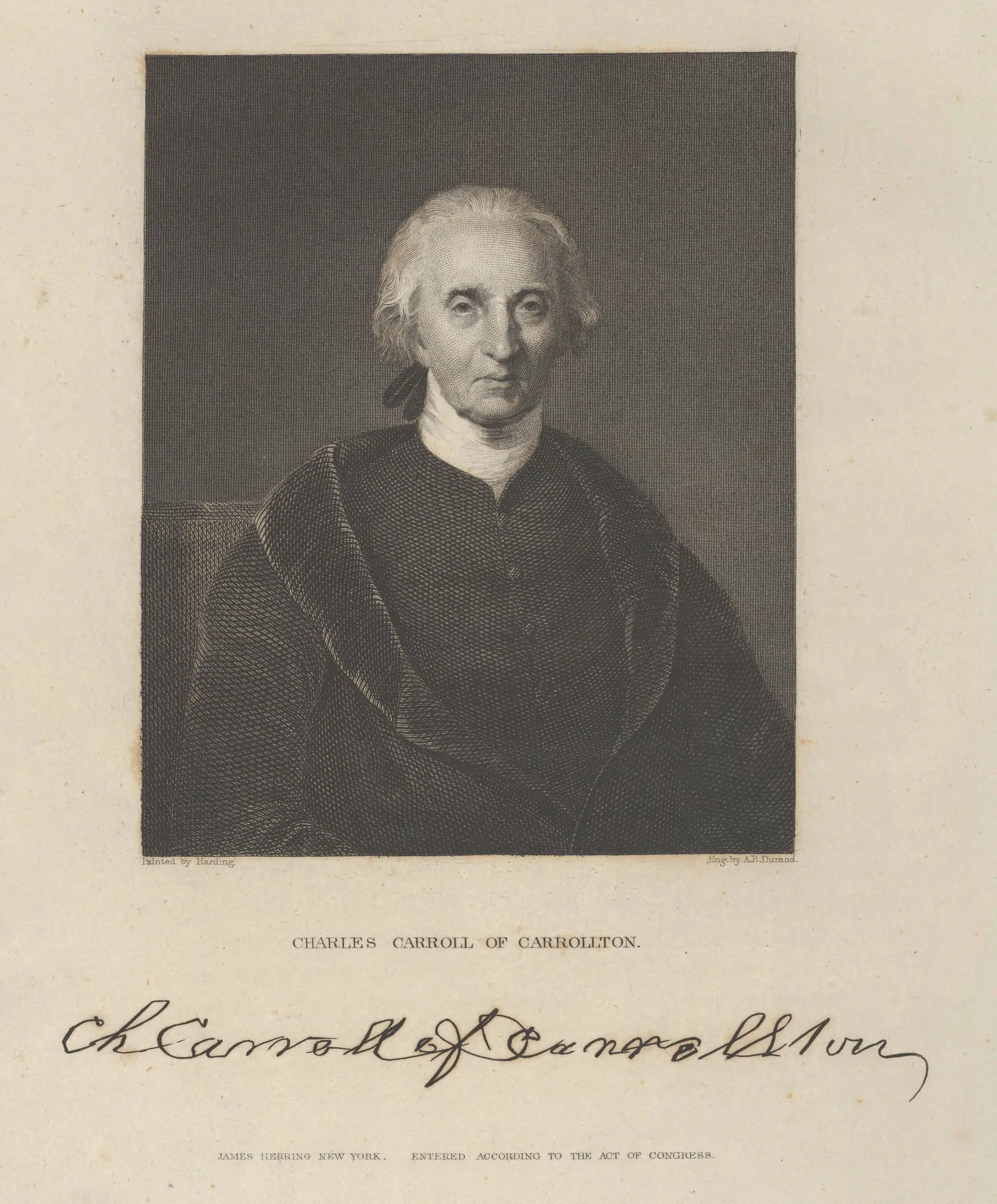
Having suffered under the anti-Catholic British monarchy, Catholics, including the Carroll family, were usually pro-revolution. Numerous Catholics participated in the independence movement—in a far greater number than their overall population would suggest. Charles Carroll, for instance, was elected in 1775 to the Continental Congress and signed the Declaration of Independence in 1776. According to tradition, when he made his signature, one member of Congress reportedly remarked, “There are so many Charles Carrolls, he can feel safe from reprisal!” But Charles quickly added “of Carrollton” after his name and retorted, “Now King George will know with whom he is dealing!”
The Constitution
Charles Carroll’s cousin Daniel Carroll also played an important role in shaping the new nation through its Constitution. A delegate to the Constitutional Convention of 1787, he was one of the few Catholics involved in drafting it. The theological training he had received, including his studies of St. Thomas Aquinas and St. Robert Bellarmine, informed his understanding of law, authority, and the common good.
He then supported the Constitution’s ratification in Maryland and helped build support for the new federal government. Later, he helped pick a site for the national capital, and when the selected site included one of his own farms, he promptly transferred it to the new government.
Together, the Carroll family and other patriot Catholics aided in the revolution against England and charted the framework for a new country that would guarantee religious freedom. These early Catholics helped forge a path for the growth of the Church in the United States. Φ
The Author