
Palm Sunday procession in Jerusalem cancelled due to war
By Beatrice Guarrera
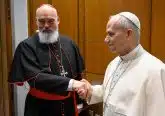
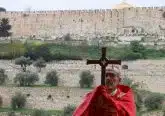
Cardinal Pierbattista Pizzaballa, Latin Patriarch of Jerusalem, has announced that the traditional Palm Sunday procession, which goes from the Mount of Olives up to Jerusalem, has been cancelled and will be replaced by a moment of prayer for the city at a location yet to be determined.
In a statement, the Cardinal explained that the Chrism Mass of Holy Thursday, usually held in the Basilica of the Holy Sepulchre, has been postponed to a later date, as soon as the situation allows and possibly within the Easter season.
Ordinary public celebrations will not be possible
“The restrictions imposed by the conflict and the events of recent days do not bode well for any imminent improvement,” the Cardinal highlighted.
“In constant dialogue with the competent authorities, together with the other Christian Churches, we are evaluating how, in the ways to be agreed upon, we can celebrate the central Mystery of our salvation in the heart of our Churches,” he said.
Cardinal Pizzaballa underlined that the situation is constantly evolving, making it impossible to provide definitive indications for Holy Week celebrations. He said the Patriarchate will be forced to organize events day by day.
“It is already clear, however, that ordinary celebrations open to all cannot take place,” the Cardinal continued, explaining the decision to cancel the Palm Sunday procession and postpone the Chrism Mass.
However, the statement did specify that the Patriarchate’s churches remain open, and parish priests and clergy will do their best to encourage prayer and the participation of the faithful in Easter celebrations.
Another wound caused by the conflict
“Due to the war, this year we were unable to experience the traditional Lenten journey in Jerusalem, with the solemn celebrations at the Holy Sepulcher and in the Holy Places of the Passion,” the statement explained.
“Though we were able to pray and prepare personally, we felt the loss of the community journey towards Easter,” said Cardinal Pizzaballa.
“The harshness of this time of war, which affects us all,” he continued, “today bears the added burden of not being able to celebrate Easter together and with dignity.”
“This is a wound that adds to the many others inflicted by the conflict. But we must not allow ourselves to be discouraged. Though we may not gather as we would like, let us not give up prayer.”
Prayer for peace on Saturday, March 28
The Cardinal recalled Jesus’ words from Chapter 18, verse 1, of the Gospel of Luke: “Pray always and do not lose heart.” He invited people to make up for these restrictions with moments of prayer in families and religious communities.
In particular, he invited everyone to unite in prayer on Saturday, March 28, by reciting the Rosary to ask for peace and serenity, especially for those suffering because of the conflict.
“We will do so with humble hearts, certain that our prayer, even while we are physically distant, is capable of drawing upon the strength of God’s love, which unites us in a spirit of hope and trust,” the Cardinal insisted.
Although prayer is already widespread, he proposed a special day in which people can feel united, despite all being in their own places.
“We desire peace, first and foremost, for our troubled hearts. Only prayer can give it,” the Cardinal wrote.
No darkness can have the last word
On Good Friday, Catholic faithful across the world will be invited to support the Holy Land through the traditional collection. The local community prepares to experience this special liturgical time with the Cardinal’s words:
“Easter, which we celebrate in the name of Christ’s passion, death, and resurrection, reminds us that no darkness, not even that of war, can have the last word. The empty tomb is the seal of the victory of life over hatred, of mercy over sin. Let us allow this certainty to illuminate our steps and sustain our hope.”
Prayer continues in the Holy Places
In recent days, the Custody of the Holy Land issued a statement explaining that the Franciscan friars present at the Holy Sepulchre “have never ceased, day or night, to carry out the scheduled celebrations, the rites, the daily processions, and the liturgical prayers according to the provisions of the Status Quo.”
“Even during these days,” the statement said, “although access to the Basilica is restricted to the faithful for security reasons, prayer continues unceasingly in the Holy Places.”
The centuries-long presence of the Custody in the Holy Land, and the prayer that rises there every day, is offered in the name of the whole Church and for the good of all humanity, the statement explained.
“In particularly dramatic moments such as those we are now experiencing, this presence intends to make visible the faith, hope, and supplication of every baptized person, so that from these Holy Places a prayer for peace and reconciliation among peoples may continue to rise.”
The Author