
Pope: Do Christians responsible for war examine their conscience?
By Devin Watkins
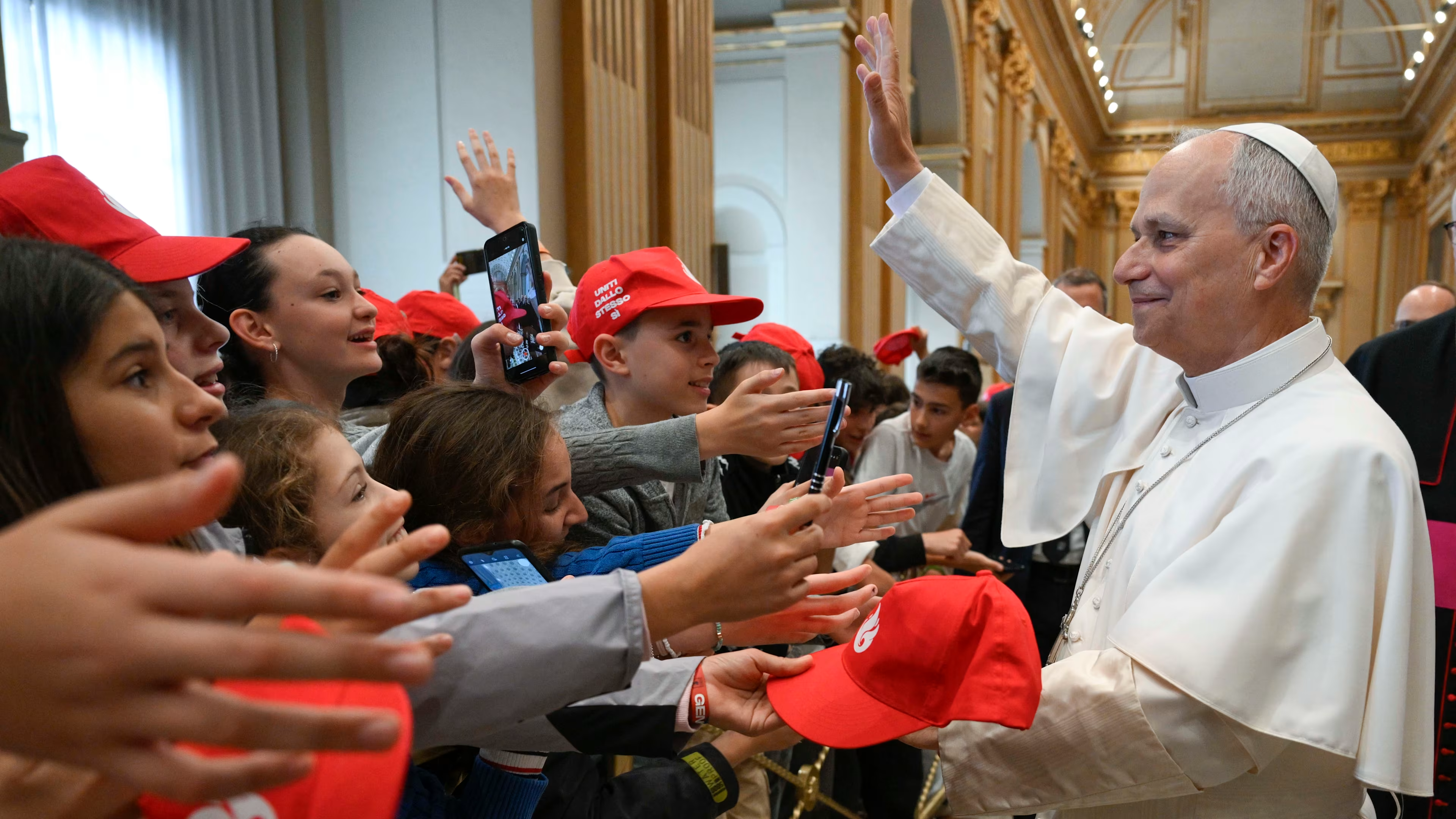
Pope Leo XIV held an audience on Friday with participants in the 36th Course on the Internal Forum, organized annually by the Apostolic Penitentiary.
The course offers priests and seminarians extended training regarding issues connected with the Sacrament of Reconciliation and typically concludes with a papal audience.
In his address to future confessors, Pope Leo reflected on the power of Confession to foster peace and unity in the human family.
“One might ask: do those Christians who bear serious responsibility in armed conflicts have the humility and courage to make a serious examination of conscience and to go to confession?” he wondered.
The Sacrament of Reconciliation, he added, offers a “laboratory of unity,” since it restores unity with God and infuses the penitent with sanctifying grace.
Confession also teaches people to live in unity with each other and with the Church, building on the interior unity which it restores to us.
“The dynamic of unity with God, with the Church, and within ourselves is a presupposition for peace among peoples,” said Pope Leo. “Only a reconciled person is capable of living in an unarmed and disarming way!”
Christians who lay down the arms of pride and allow themselves to be renewed by God’s forgiveness then become agents of reconciliation in their daily lives, he said.
At the same time, people reconcilied with God recognize more easily the “unfulfilled promises of unbridled consumerism and the frustrating experience of a freedom detached from truth.”
By divine mercy, said the Pope, Christ awakens within us a sense of our incompleteness, bringing to the surface existential questions that help us realize that only Christ Himself can fully respond to our deepest desires.
“God became man to save us,” he said, “and He does so also by educating our religious sense, our inextinguishable desire for truth and love, so that we may welcome the Mystery in which ‘we live and move and have our being’.”
Turning to the importance of the Sacrament of Reconciliation, Pope Leo XIV recalled the Church’s ancient theological understanding of confession, which has developed over time and requires every Catholic to receive the sacrament at least once a year.
However, he said, many people fail to draw near to the “infinite treasure of the Church’s mercy” more frequently, rather than approaching the confessional with simplicity of faith and heart to receive the Lord’s gift.
Pope Leo invited current and future priests to remain aware of their great responsibility to offer God’s forgiveness through the Sacrament of Reconciliation.
He pointed to the many priests who became saints in the confessional, including St. John Mary Vianney, St. Leopold Mandić, and more recently, St. Pio of Pietrelcina and Blessed Michał Sopoćko.
As sacramental confession builds up a person’s interior unity, it also builds up the Church herself, giving her new energies to engage with society and the world, he said.
In conclusion, Pope Leo urged confessors to receive the Sacrament of forgiveness themselves “with faithful constancy,” so that they may become ministers of divine mercy, of which they are the first beneficiaries.
The Author