
The Ancient Providers and Protectors of God’s Family
Church Fathers Series: Part 7
Stories matter. What you watch matters. What you listen to matters. What you scroll through matters. Whatever you take into yourself has an effect, and there are a lot of stupid stories out there.
How do we navigate through the narrative wildness of “NetflInstaTok”? Well first, I’d recommend more silence (like, a lot more). But then, I’d insist that you get to know our own story. We accept junk because we don’t know the goodness and glory of our inheritance. As baptized Catholics, we have been taken up into the most beautiful story of all time, but I don’t know how many of us know the plot. The Church Fathers can really help us here. They could still hear the echo of the Apostles when they introduced God’s story to the ends of the known world.
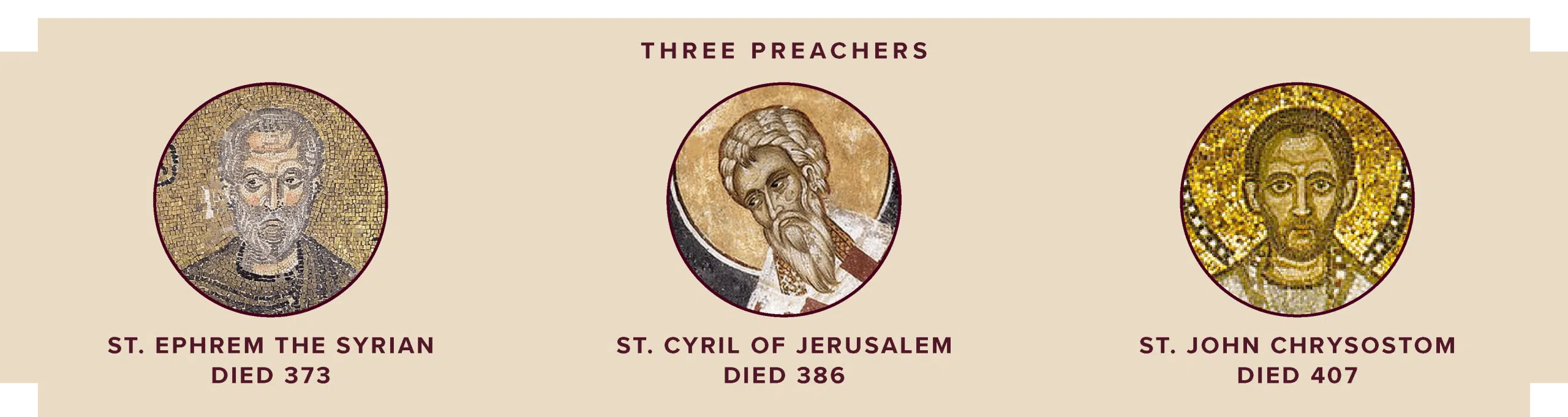
The Fathers communicated God’s saving story less by writing books (though they did some of that) than by preaching, and this month, we are looking at three of the greatest preachers of all time. The preacher is kind of a supernatural storyteller with three goals: he wants us to see God’s story 1) told in Scripture, 2) presented in the liturgy, and 3) enacted in our lives.
One of the richest ways he can accomplish these is through something called typology. God tells stories by repeating patterns (typoi), and the preacher tries to teach his congregation how to see and experience these patterns, then live them.
Take St. Ephrem the Syrian who preached in Nisibis and Edessa on the Roman Empire’s eastern border. Before teaching his people how to live, he taught them how to see. He was a poet theologian who showed the superabundant richness and interconnection of Scripture. One of his favorite images was “the robe of glory.”
Ephrem explained to his congregation that Adam and Eve were originally endowed with grace that was worn as a robe of glory in the garden of Eden. In our sin, we lost the robe, and we were ashamed of our nakedness. On Mount Sinai, God began to robe us back with glory when He commanded His priests to vest in magnificent robes when they served Him in the tabernacle. But what about the rest of us? When do we get our robes back? It is not until the Word who is robed with glory in heaven comes down to earth that grace and glory are restored to mankind.
Ephrem directs our attention to the baptism of Jesus. The waters didn’t cleanse Jesus because Jesus didn’t have sin. Instead, Jesus placed His own robe of glory in the waters so that all of us who are then baptized in water can once more be clothed in Christ and robed in His glory. What was lost in the garden is restored in baptism.

This typological connection leads to our next Father, St. Cyril of Jerusalem. Cyril had the privilege of preaching in the very place where Jesus died and rose from the dead. He especially wanted to show his people that the story that took place three centuries before still continued in the present day. Cyril is famous for his sacramental catechesis in which he prepared his people for the sacraments of initiation then explained what happened in baptism, confirmation, and the Eucharist.
Liturgy is not some empty ritual but a deeper participation in reality. In the sacraments, God’s saving hand reaches out through tangible materials and continues to write His story in us. When water flows over our head and those holy words are spoken, we don’t just remember the death and resurrection of Jesus: we die with Him, and we rise with Him. Through the oil of confirmation, the Holy Spirit actually descends upon us. And as bread and wine are transformed into the Eucharist, we really partake in the Body and Blood of Jesus.
Finally, St. John Chrysostom teaches us how to live the story that God spoke in Scripture and that He continues to speak in the liturgy. Chrysostom first preached in Antioch before moving to Constantinople, where he preached some of the greatest homilies of all time. St. Thomas Aquinas once said that he would rather possess Chrysostom’s commentary on the Gospel of Matthew than own the city of Paris!
John is called “golden-mouthed” (Chrysostom in Greek) for a reason. He had the great gift of making the Gospel come alive. Whether before emperors or his regular Sunday congregation, Chrysostom showed the beauty of the Gospel made flesh, here and now. He was particularly concerned about the poor and raising good families. If we have been baptized into the family of God, we better start acting like the children of God. Chrysostom said we shouldn’t listen to the world which tells us to take for ourselves; we must listen to Jesus who tells us to sacrificially love and give till the end.
Christianity is the greatest story of all time. And it’s true. It was foretold by the prophets, fulfilled in Jesus, proclaimed by the Apostles, and continues in the Church. Ephrem, Cyril, and Chrysostom took up the story. So should you.
Further Reading
St. Ephrem the Syrian, Hymns on Paradise (Popular Patristics, St. Vladimir’s Seminary Press, 1997)
St. Cyril of Jerusalem, Lectures on the Christian Sacraments (Popular Patristics, St. Vladimir’s Seminary Press, 1977)
St. John Chrysostom, On Marriage and Family Life (Popular Patristics, St. Vladimir’s Seminary Press, 1986)
Andrew Hofer, The Power of Patristic Preaching: The Word in Our Flesh (The Catholic University of America Press, 2023)
Martin Shaw, Liturgies of the Wild: Myths that Make Us (Sentinel, 2026)
The Author