
The Burghers of Calais
A Guide to Visio Divina
Invite the Holy Spirit to enlighten your experience as you gaze at the artwork. Notice what thoughts and emotions enter your heart and mind. Be still. Pray with the image as you are led.
“Sacred art by being true and beautiful should evoke and glorify the mystery of God made visible in Christ, and lead to the adoration and love of God, the Creator and Savior, who is the surpassing, invisible Beauty of Truth and Love” (Compendium of the Catechism of the Catholic Church, 526).
Background
The Eucharistic Prayer II says, “At the time He was betrayed and entered willingly into His Passion, He took bread and, giving thanks, broke it…” The adverb willingly is curious. One might argue that Jesus exhibited reluctance in the Garden of Gethsemane before His Passion when, in agony, He prayed, “My Father, if it is possible, let this cup pass from me. Yet not as I will, but as You will” (Mt 26:39). A homilist explained that Jesus’ prayer expressed profound human dread over His impending suffering, but His dread does not negate that He willingly handed himself over, as His Father desired.
It is precisely that paradoxical mix of willingness and reluctance that Auguste Rodin captured in his groundbreaking piece, The Burghers of Calais. The bronze sculpture is a public monument to the six burghers—or citizens—who, in 1347, volunteered to ransom themselves to England’s King Edward III in exchange for the besieged city’s freedom. They offered up their lives to liberate their fellow townspeople from starvation.
When the Hundred Years’ War began, King Edward III claimed the French crown. He captured and blockaded Calais, a major port city on the northern coast of France, starving its citizens for nearly a year. The story was recounted in Jean Froissart’s chronicles around 1360. Froissart described the wretched famine: “Many were losing their bodies and their souls from madness caused by hunger” (quoted by Levkoff, in Rodin: A Magnificent Obsession, 47).
The king stipulated: “The only mercy they can have from me is if six of their most notable burghers leave their city, stripped, with ropes around their necks and the keys in their hands: and with them I shall do as I please” (quoted by Levkoff, 47). In response, the wealthiest property owner, Eustache Saint-Pierre, stood up and said, “I shall find grace and forgiveness in our Lord God if I die to save these people, that I want to be the first, and I willingly strip down to my undershirt, with a noose around my neck, for the will of the king of England” (quoted by Levkoff, 47–48). The crowd wept bitterly as, one by one, five other emaciated townsmen stood and joined the first. They walked as a unit to the town square to meet their fate, where the king had ordered his executioner to wait.
Rodin’s Pursuit of the Truth
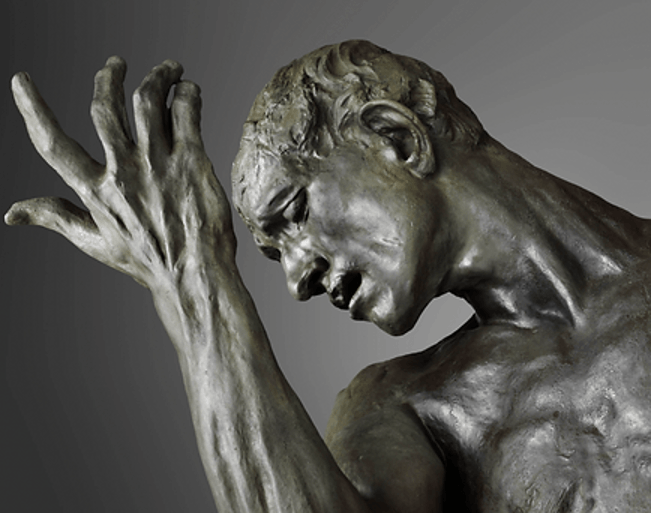
In 1884, Rodin captured this walk to the square. Departing radically from French academic norms used to portray heroism, he shifted the focus from triumphant glory to human suffering. The city had called for artists’ submissions to honor Eustache Saint-Pierre in a commemorative monument, and Rodin’s design was accepted from the pool of sculptors’ maquettes. His sculpture included all six burghers walking reluctantly to meet the king, their feet oversized, anchored to the ground. Each figure meditates differently on his imminent death.
Rodin arranged the figuresin a circle, ignoring hierarchy and refusing to highlight any onefigure. Each gaunt burgher draped in tattered sackcloth personifies individual responses to his fate. One buries his head in his hands making a confession. Another steps forward; stoic, jaw set, gripping a giant key with both hands. The drama is heightened by the heroes’ diverse and ambiguous poses. They form a human rosary, trapped in a timeless march of fear, courage, despair, and heroic determination. Vividly displayed are the virtues of valor and self-sacrifice but mixed with the truth of abject fear.
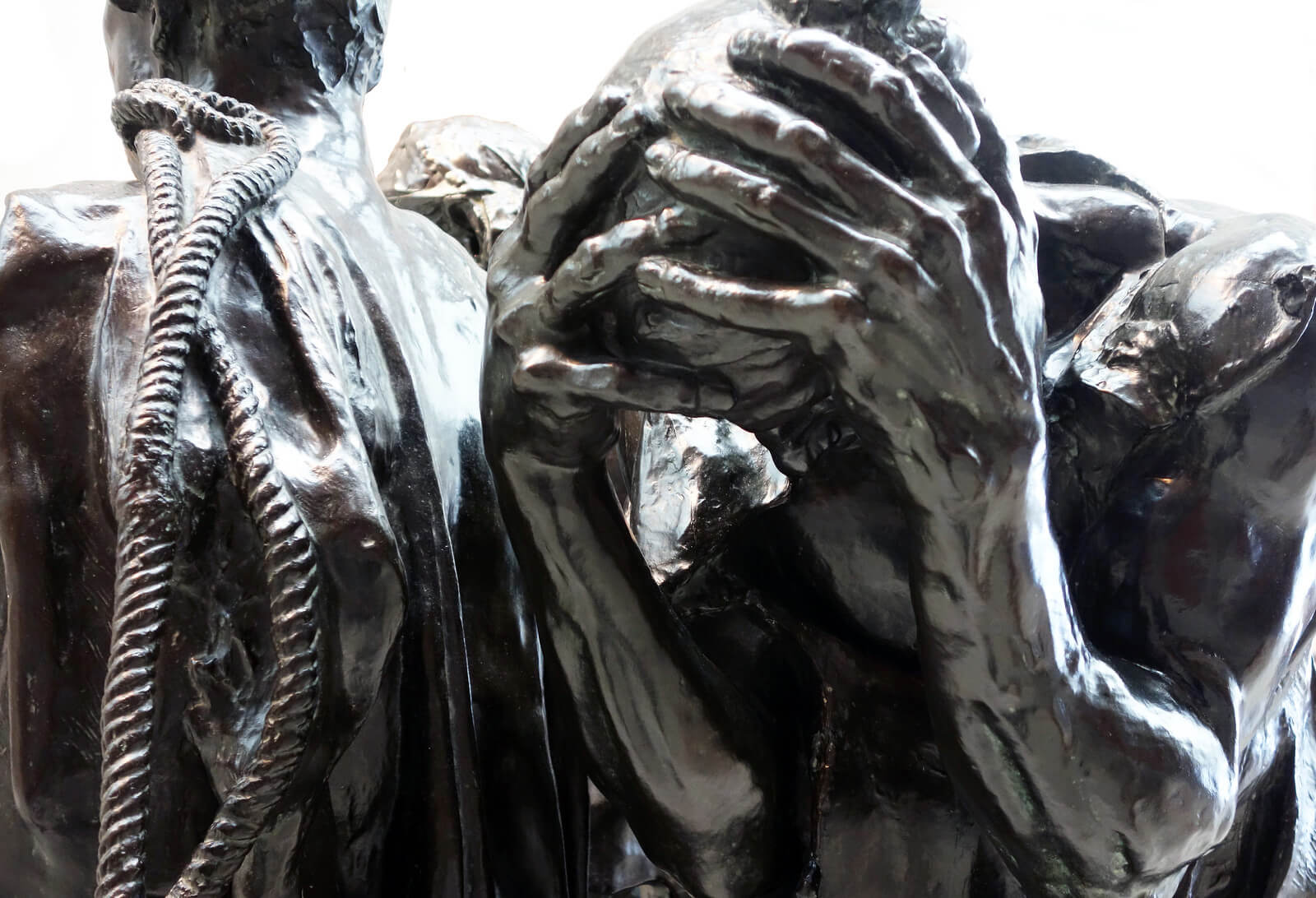
Concerned above all with telling the truth, Rodin achieved great beauty, and his work forever changed civic memorial sculpture. But his path was not easy; the project met resistance at every step.
Representing the general consensus, one committee member said, “It was not like this that we envisioned our glorious fellow citizens … Their dejected attitudes are an offense” (Grunfeld, 251). Rodin’s struggles mounted as the expense of casting six figures far exceeded the budget.
Furthermore, Rodin stipulated that the aggregate composition should not be placed on a typical high pedestal but instead on the ground in the public square, where contemporary citizens could walk in solidarity with the heroes. Yet, the committee installed the finished piece on an elevated pedestal and fenced it off in a remote park. In 1924, the pedestal and fence were removed and the sculpture was placed on the ground in front of the town hall—seven years after Rodin’s death.
The Christological theme has not been lost on viewers through the ages: “No one has greater love than this, than to lay down one’s life for one’s friends” (Jn 15:13).
The Author