




The Ancient Providers and Protectors of God’s Family
Church Fathers Series: Part 5

In the beginning was the Word, and the Word was with God, and the Word was God. You’ve probably heard that hundreds of times. It’s the beginning of the greatest text ever written, John’s Gospel, but what does it actually mean? More specifically, what does the word “Word” mean? How can a “word” be God? And, making it even more mysterious, John tells us that this same Word became flesh and dwelt among us (Jn 1:14).
He is in the beginning, yet He entered time. All things came to be through Him, yet He became flesh. We know His name, but could we ever know who He really is? Well, this is the mission of our lives. In fact, John tells us that this is eternal life, that we know the only true God and Jesus Christ whom He sent (Jn 17:3). The stakes are high, so it’s a good thing we have the Church Fathers to help us. These Fathers pass down the same Word of life that the Apostles looked upon and touched with their hands: they proclaimed it also to us that we may have fellowship with them and with the Father and His Son (1 Jn 1:1-4).
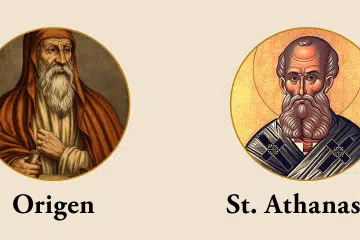
The Greek word for “word” is logos, and it means a lot more than word: it can also mean a whole story or reason in general. In Greek philosophy, logos was used to describe the principle of all reality: the singular word of all existence, Reason with a capital “R.” Without this Word, math doesn’t make sense; there is no beauty in the night sky; and we couldn’t call a baby’s laugh good. One of the first teachers of the Church to bring out the significance of the logos was Origen of Alexandria (185–254).
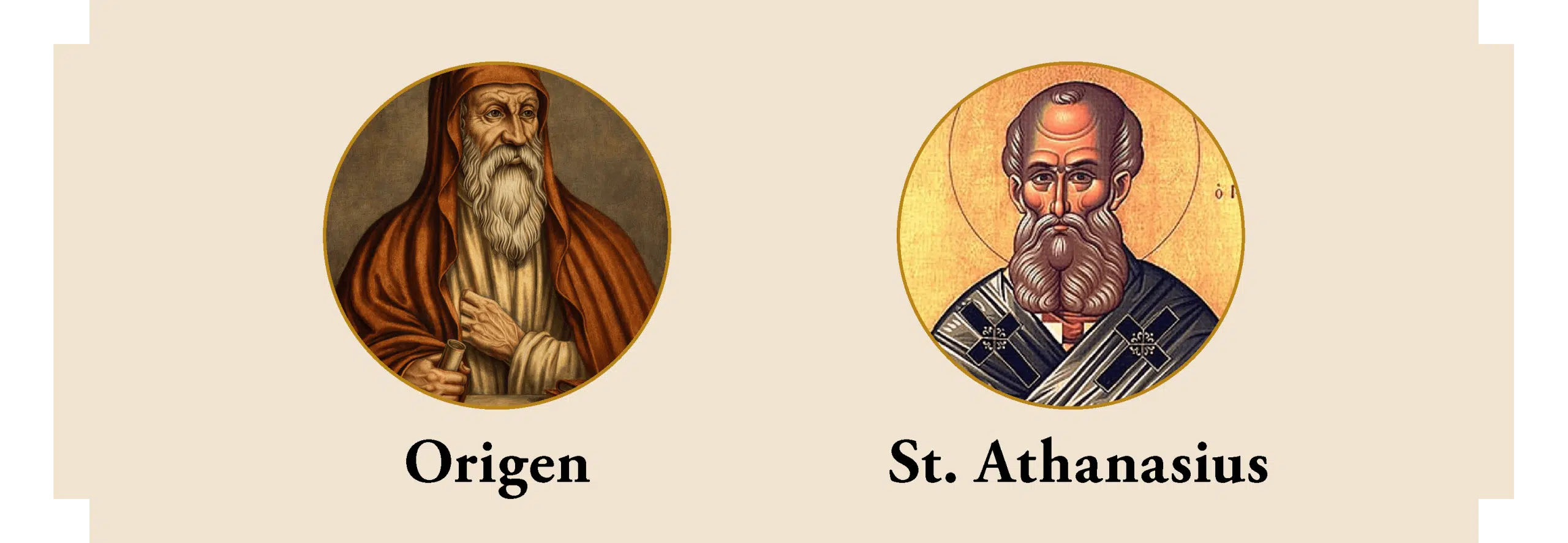
In his writing, Origen always sought for the Word of God amid the words of Scripture. For Origen, and all the Fathers after him, Scripture is a multi-layered text. There is the literal or historical meaning on the surface, but the higher goal is to plumb the depths of Scripture to find its spiritual significance. Origen found the Word speaking on every page. When he read the Song of Songs, he didn’t just find an ancient love poem: he heard the divine Word as the Bridegroom wooing us, His beloved bride, the Church.
Origen wanted to be a martyr for the Word made flesh, and he died in communion with the Church, but his theology wasn’t perfect. Sometimes, he went too far in his speculations, and some of his followers were later condemned. The most immediate controversy after his death related to how Origen spoke about the Word. In some passages, Origen clearly explained that the Word was eternally begotten by the Father; but in other texts, Origen seemed to suggest that the Word was a kind of subordinate “God.”
In the same city where Origen was born, Alexandria, the problem came to the fore when a young, hot-shot priest named Arius got into a fight with his bishop, Alexander. Arius preached that the Word was a kind of intermediate deity created by the Father. Alexander vehemently disagreed. News of this argument reached the newly-Christian Roman emperor, Constantine, who called a large meeting to address the issue (along with a couple other orders of business). Bishops from across the empire met in Nicaea in 325, where they ultimately condemned Arius and gave us the Nicene Creed: Jesus is begotten, not made—truly God from God and consubstantial with the Father.
Jesus gave us the Church to guide us into all truth. This first ecumenical council spoke with divinely sanctioned authority to guard the one faith handed down by the Apostles, even as it used new terms to do so. But Nicaea did not solve the debate about Jesus: the new terms that it used had furthered the conversation. The work of doctrinal development that St. John Henry Newman described (An Essay on the Development of Christian Doctrine) is never easy. There are labor pains as the Word is born in human speech.
After Alexander died, a young deacon at the council named Athanasius (circa 297–373) was made bishop of Alexandria. For over 40 long years, Athanasius had to struggle to show the significance of the Nicene Creed: Jesus is the Word, and the Word is true God, and the Father is true God, but there are not two Gods. His defense involved an intense examination of Scripture.
Like Origen, Athanasius found the Word speaking throughout Scripture, and he clarified that sometimes the Word was speaking in His divinity and sometimes according to His Incarnation. For instance, when Proverbs 8:22 records Wisdom saying, The Lord created me at the beginning of His work, Athanasius reminds us that this cannot refer to the Word in His divinity since all things were created through Him. Instead, the creation of Wisdom refers to the Incarnation of the Word in time.
All of this theological speculation may seem bewildering, but Origen and St. Athanasius invite us into a mystery. In theology, a mystery is not something that we cannot know but something about which we can always know more. Origen and St. Athanasius are calling us to contemplate the mystery of the Word found in creation, spoken of in Scripture, and revealed fully in Jesus. This contemplation leads to eternal life, for as Athanasius wrote: the Word of God was made man so that we might be made God.
For further reading
Origen (Classics of Western Spirituality, Paulist Press, 1979)
St. Athanasius, On the Incarnation (Popular Patristics Series, St. Vladimir’s Seminary Press, 2012)
John J. O’Keefe & R. R. Reno, Sanctified Vision: An Introduction to Early Christian Interpretation of the Bible (The Johns Hopkins University Press, 2005)
Khaled Anatolios, Athanasius (The Early Church Fathers Series, Routledge, 2004)
Samuel B. Johnson, The Life of Jesus in the Writings of Origen of Alexandria (Cambridge University Press, 2025)
The Author