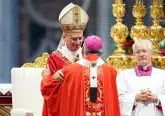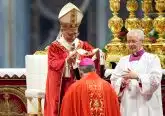

Pope Leo XIV presented with lambs on feast of St. Agnes
Two lambs were presented to Pope Leo XIV on the liturgical feast of St. Agnes, in keeping with an ancient tradition of the Roman Church.
Vatican News
On Wednesday, January 21, in the Vatican’s Urban VIII Chapel, Pope Leo XIV was presented with two lambs on the occasion of the Memorial of St. Agnes of Rome.
Following an ancient tradition, the animals were later blessed in the Basilica of St. Agnes Outside the Walls in northern Rome, where the young 4th-century martyr is buried.
As is customary, the wool from these lambs will be used to make the Pallia for the new Metropolitan Archbishops.
The Pallium is a liturgical insignia of honor and jurisdiction worn by the Pope and Metropolitan Archbishops in their churches and in those of their ecclesiastical provinces. It consists of a narrow band of white woolen cloth decorated with six black silk crosses.
The rite of blessing and imposition of the pallia is performed by the Pope on June 29, the Solemnity of Sts. Peter and Paul.
An ancient tradition
The first mention of the tradition of blessing two lambs on the feast of St. Agnes dates back to the 6th century.
It is tied to an ancient legend about her life that says that she appeared to her parents after her death when they came to pray at her tomb. They saw her surrounded by a choir of virgins and holding a pure lamb in her arms.
Historical records also indicate that two lambs were once considered the “rent” paid by the monks of the Basilica of St. Agnes Outside the Walls to the Basilica of St. John Lateran. Members of the Lateran Chapter would present these lambs to the Pope for his blessing.
For many centuries, lambs from the Trappist farm at the Abbey of the Three Fountains in southern Rome were taken directly from the Basilica of St. Agnes to the Pope to be blessed.
Then the lambs would be sent to the Benedictine nuns of the Basilica of St. Cecilia in Trastevere, who would shear them during Holy Week, so that the wool could be woven into the pallia for the new archbishops.
In recent years, some aspects of this tradition have changed as the Trappists no longer maintain the sheep farm, and the Pope does not bless the lambs at the Vatican. However, the Benedictine nuns still shear the lambs to make the new pallia.
The Author