The Ancient Providers and Protectors of God’s Family
The Church Fathers | Father Jacob Lindle
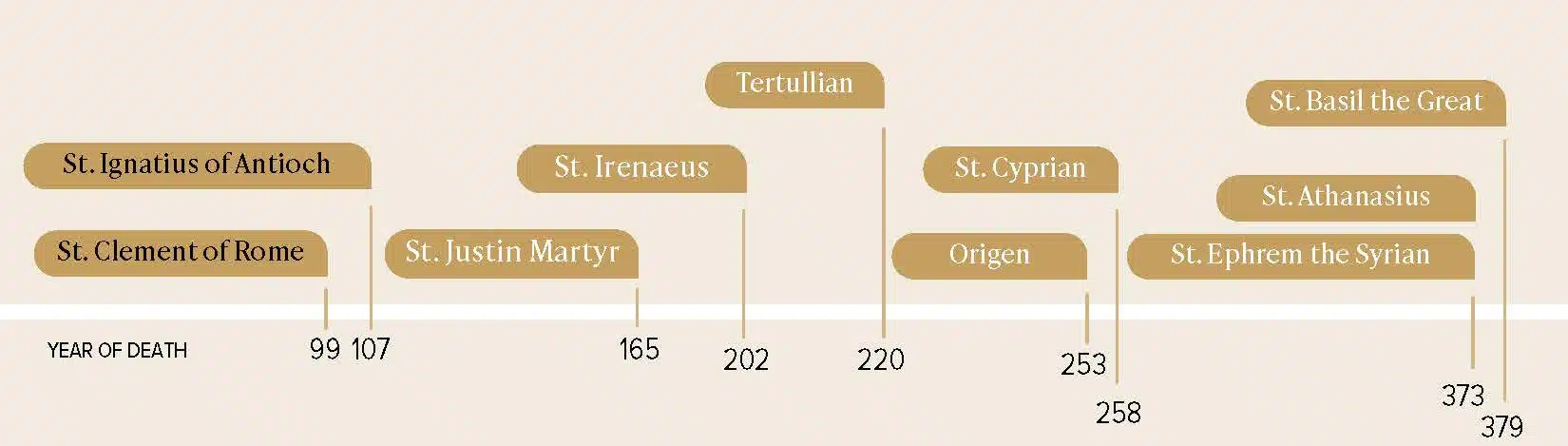
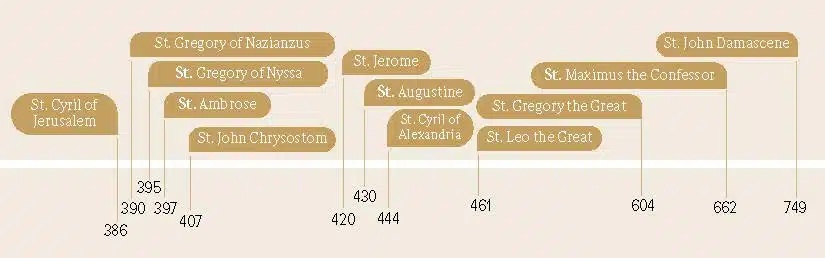
God is real. You know how I know? Because the Catholic Church still exists. Think about it: the visible Church of God was founded (Mt 16:18) almost 2,000 years ago upon a volatile fisherman from Galilee (approximately nowhere according to the Roman Empire), and after a whole host of saints and sinners and the rise and fall of kingdoms, that same visible Church exists today led by Peter’s 266th successor, Leo XIV. I will not leave you orphans, Jesus said (Jn 14:18), and His word is true: invisibly, He has poured out the Spirit of adoption into our hearts by which we cry ‘Abba Father’ (Rom 8:15), and visibly, He has always given us priests, bishops, and a pope (Papa, πάππας, a dad) to lead the Church on earth while He reigns in heaven. God always provides and protects, and He always gives us providers and protectors—some of whom we call Church Fathers. This month, we begin with St. Clement of Rome and St. Ignatius of Antioch, who are named Apostolic Fathers because they were in immediate contact with the Apostles themselves. So, how did these dads defend and develop the divine deposit of faith.
St. Clement was the fourth pope (after Peter, Linus, and Cletus) and we only have one work from him: 1 Clement (either AD 70 or 97), a letter responding to a schism in the Corinthian church where lay persons who were jealous of the hierarchy broke communion and tried to create their own clergy and church. Pope Clement was having none of it. Just as Paul previously corrected the church in Corinth through letters, Clement took up the quill, from the city where Paul shed his blood, to bring the Corinthians back into communion with the apostolic Church. As he defended the Church against schism, Clement provided us with the earliest testimony of apostolic succession outside of Scripture. He explains that, like links in an unbroken chain, bishops connect us to the Apostles, who connect us to Christ, who connects us to God. Already, in the first century, Peter’s third successor explains:
Our Apostles also knew, through our Lord Jesus Christ, that there would be contention over the bishop’s office. So, for this cause, having received complete foreknowledge, they appointed the above-mentioned men, and afterwards gave them a permanent character, so that, as they died, other approved men should succeed to their ministry. —1 Clement 44:1-2
The Catholic Church didn’t create the hierarchy: we received it from Jesus and the Apostles. And Clement shows us that this authority is not about power for itself; it is God’s gift to serve charity and unity.
And what about St. Ignatius? He was the third bishop of Antioch, where Peter was first bishop before going to Rome. Ignatius followed in Peter’s footsteps after he was arrested and brought in chains to the Eternal City. Along the journey, Ignatius wrote six letters to local churches and one to Church Father St. Polycarp. These are must-reads: they are from AD 107 and are some of the most eloquent and passionate testimonies to the Faith of all time. Like Clement, Ignatius was passionate to defend Church unity:
Shun schisms, as the source of troubles. Let all follow the bishop as Jesus Christ did the Father, and the priests, as you would the Apostles… Wherever the bishop appears, there let the people be; as wherever Jesus Christ is, there is the Catholic Church. —Smyrnaeans, 8
Ignatius was the first to call the Church “Catholic,” and he did everything to protect her universal (catholic) unity. A big obstacle to this unity was the heresy called Docetism, which held that Christ only seemed to be a man and only seemed to suffer and die, while He was “really” only a spirit. In defending the Church against this heresy, Ignatius not only provided another powerful explanation of Church unity and hierarchy, he also provided a powerful witness to the Church’s Eucharistic faith. Listen to what he says about the Docetists who don’t go to Mass:
They abstain from the Eucharist and from prayer because they do not admit that the Eucharist is the flesh of our Savior Jesus Christ, the flesh which suffered for our sins and which the Father, in His graciousness, raised from the dead. —Smyrnaeans, 6
Christ Jesus gave His real Flesh for the salvation of real people, and we mystically partake of this real Flesh at every Mass. Already in the year 107, we find testimony that the real Jesus founded the real Catholic Church, which is continued through real bishops and centered on the real Presence of Jesus in the Eucharist. It is a real faith worth living for, and as both Clement and Ignatius show us, it is a real faith worth dying for.
For further reading:
The Apostolic Fathers, “The Fathers of the Church,” vol. 1 (Catholic University of America Press)
Kenneth D. Whitehead, One, Holy, Catholic, and Apostolic (Ignatius Press)
Joe Heschmeyer, The Early Church Was the Catholic Church (Catholic Answers Press)
 Fr. Jacob Lindle was ordained a priest for the Archdiocese of Cincinnati in May 2022. He is presently studying for a Doctorate in Patristic Theology at the Pontifical Gregorian University in Rome.
This article appeared in the February 2026 edition of The Catholic Telegraph Magazine. For your complimentary subscription, click here.
The Author