The Church Fathers: The Ancient Providers and Protectors of God’s Family
by Fr. Jacob Lindle
Every Sunday, you stand up from your creaky pew and proclaim, “I believe in one, holy, catholic, and apostolic Church.” Now, how on earth do you believe that? There are tens of thousands of Christian denominations around the globe, and yet, there you are at your Catholic Mass in your Catholic archdiocese with the audacity to announce that, with Leo our Pope and Robert our bishop, you have full communion with the very Church Jesus Christ Himself founded. Maybe you’ve never thought about it, but that’s crazy. The good news, though, is that it’s also true.
I know I’m a priest so I have to say that, but you don’t just have to take my word for it. In the 1800s, there was an Anglican priest named John Henry, and John Henry didn’t like Roman Catholics very much. He thought we worshipped Mary and added all kinds of things to the Gospel. This John Henry fellow, however, was brilliant. He could fluently read Greek and Latin, so he started reading all the documents from the first centuries after Christ to show how the first Christians were so different from the Catholics of today. He studied figures like Athanasius and Cyril of Alexandria, Augustine and Leo. He was shocked by what he found: even the earliest Christians sounded like Catholics! He resisted and resisted because of his prejudice against Rome, but he eventually came to see his conversion to the Catholic Church as an entry into fullness. He had learned to love God and Scripture as an Anglican, and he wasn’t rejecting that: he was simply receiving even more.
Well, as you might know, this Englishman was then ordained a Catholic priest, made a cardinal by Leo XIII, beatified by Benedict XVI, canonized by Francis, and is now declared a Doctor of the Church by Leo XIV. St. John Henry Newman is a great figure to promote our upcoming series on the Church Fathers, not only because the Church Fathers made him Catholic but because he shows us a great method to understand them. It was from the Church Fathers that Newman learned his theory of doctrinal development.
Unlike some caricatures you may have heard, the “development of doctrine” does not mean that Church teaching simply changes with the times—as Newman knew well from the Fathers, the deposit of Faith that Jesus entrusted to the Apostles cannot and will not change. What can grow, however, is our own conscious understanding of it and our precise articulation of it. Within the preaching of the Apostles and the record of Scripture, for example, we find the presence of the Trinity, but we never once find the word “Trinity.” This addition of identifying the presence by the word “Trinity” is really a clarification. Authentic development does not corrupt doctrine, but like a seed to a tree or a baby to a man, development reveals growth while also remaining essentially the same.
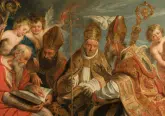
This is why God gave us the Church Fathers: they help the Church grow in her understanding of the faith while also defending that one faith from corruption. Just like an earthly father provides for his children and protects them from harm, the Church Fathers provide for the Church with rich teaching and protect her from schism and heresy. We know, of course, that Jesus tells us to call no man “father” (Mt 23:9), but we also know this must not be understood literalistically; if it were, St. Paul would be in some trouble for writing, “I became your father in Christ Jesus through the gospel” (1 Cor 4:14–15). The point here is that no one should be a father who does not point to God the Father. The Church Fathers are fathers precisely because they reflect God’s profuse paternal love for His Church.
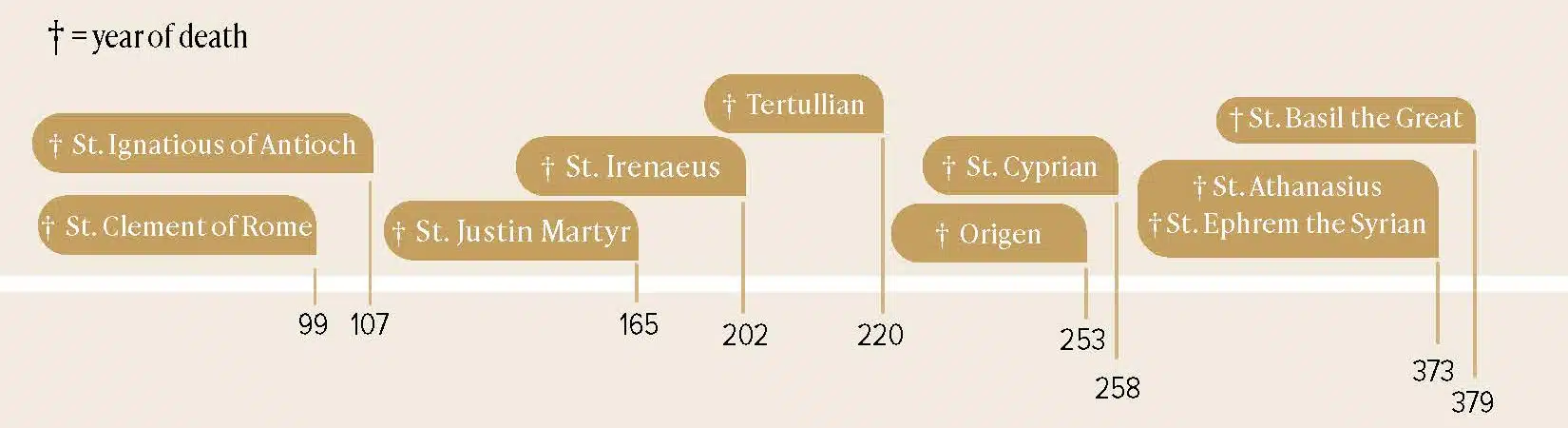
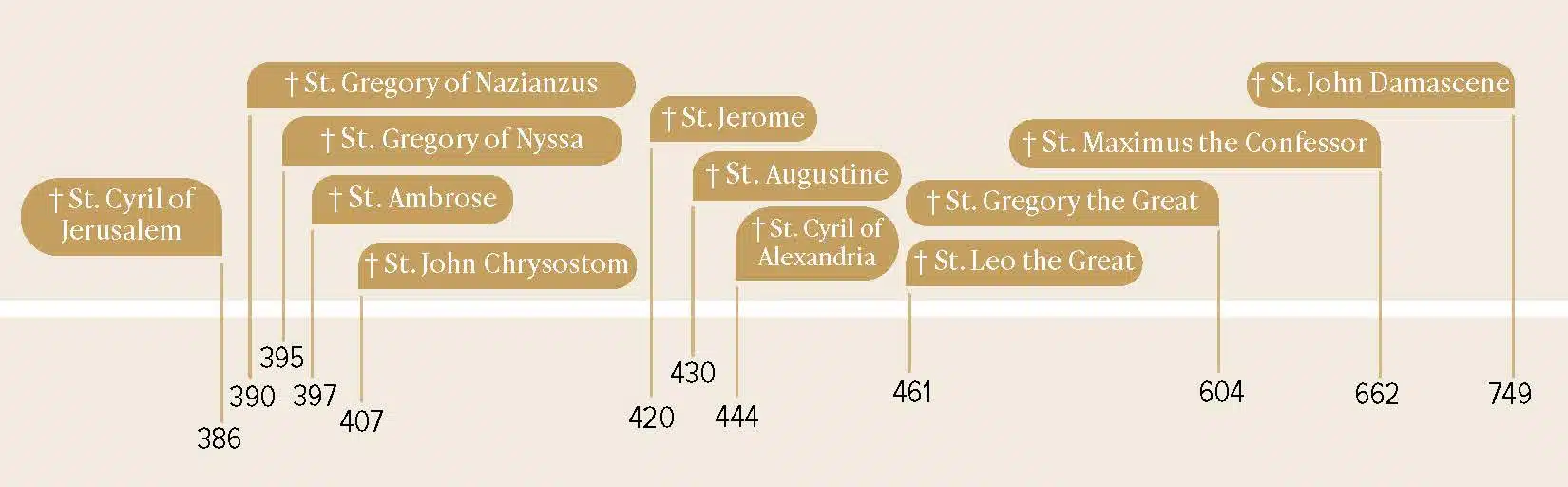
So, who exactly qualifies as a Church Father? A Church Father himself asked that very question, and St. Vincent of Lérins offered four qualities: 1) antiquity, 2) sound teaching, 3) holiness, and 4) Church approval. If we take “antiquity” to mean between the time of the Apostles and the eighth century, there are well over 100 men who qualify—some lists record over 200. Sadly, I don’t have it in me to do a 16-year series, but over the next year, we will have the chance to look at some of the greatest Fathers spanning these first centuries. In our journey, we will find Fathers who gave their all to provide for and protect the sacred Tradition entrusted to them. We will find the greatest of all families in the one, holy, catholic, and apostolic Church. And we will find a faith worth living for and worth dying for. May St. John Henry Newman and all the Fathers of the Church intercede for us along the way.
 Fr. Jacob Lindle, ordained a priest for the Archdiocese of Cincinnati in May 2022, is presently studying for a Doctorate in Patristic Theology at the Pontifical Gregorian University in Rome.
This article appeared in the January 2026 edition of The Catholic Telegraph Magazine. For your complimentary subscription, click here.
For further reading:
Benedict XVI, Church Fathers: From Clement of Rome to Augustine
Mike Aquilina, The Fathers of the Church: An Introduction to the First Christian Teachers
Robert Louis Wilken, The First Thousand Years: A Global History of Christianity
Jimmy Akin, The Fathers Know Best: Your Essential Guide to the Teachings of the Early Church
John Henry Newman, An Essay on the Development of Christian Doctrine (beware of fancy writing!)
The Author