

What Building the Kingdom Does Not Look Like

by Emma Cassani
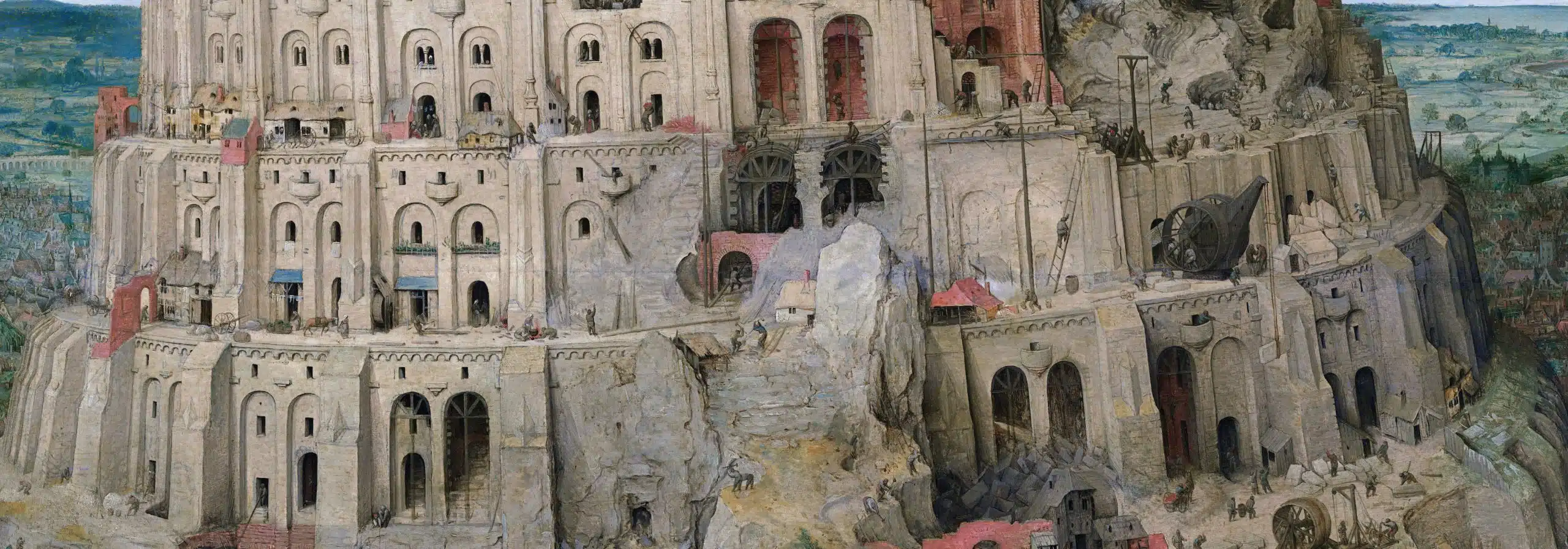
Spend a moment meditating on The (Great) Tower of Babel (ca. 1563), painted by Pieter Bruegel the Elder. It can be found at the Kunst History Museum in Vienna, Austria. Then read Genesis 11:1-9.
Background
The (Great) Tower of Babel was painted during the Northern Renaissance, a period known for its extraordinary attention to detail. Artists of this era often filled their work with tiny narratives tucked inside larger scenes—worlds within worlds—inviting viewers to slow down and notice. Pieter Bruegel the Elder was exceptionally skilled at this. His paintings reward patience: the longer you look, the more you discover.
In this painting, Bruegel blends biblical imagining with the busy innovation of 16th-century Europe. Cities were expanding, trade was flourishing, and construction cranes stood beside unfinished towers across the skyline of Antwerp, where he lived. Ambition was everywhere. Bruegel was so fascinated by human ambition—its beauty, its energy, and its danger—that he created three different versions of the Tower of Babel. First came The (Great) Tower of Babel—the most monumental of the three—painted on wood panel, measuring 45 x 61 inches. Within the same year, he produced The (Little) Tower of Babel, roughly half the size. The third was a miniature painted on ivory, which has unfortunately been lost to history.

Enter In
As you step into the painting, the air is thick with dust. From a distance, crowds of workers swarm around the rising structure. Tower doesn’t feel like the right word—more like a colossal fortress carved into a mountain, peaking just above the clouds. Ships line the coast with imports; workers unload crates and haul materials onto pulley systems. Others lug bricks up ramps, staircases, and ladders. The whole plain seems to vibrate with one intention: build.
But as you walk closer, you notice something unsettling. A cracked archway. A section built too quickly, already caving under its own weight. The higher the tower rises, the more its foundation seems to crumble. Shouts echo against unfinished walls, and what started as a somewhat coordinated effort dissolves into chaos. Voices shift—growing sharper and louder, charged with confusion. Commands are repeated, but no longer understood.
The tower in Pieter Bruegel the Elder’s painting is remarkably impressive, expanding in width and depth as it spirals upward with meticulous detail. Dr. Zucker, an art historian, playfully exclaims, “What we see here is Pieter Bruegel the architect!” Bruegel invented this massive, chaotic structure. However, the architecture does look slightly familiar, with its arched levels, elliptical form, and tiered construction resembling Rome’s Colosseum (Flavian Amphitheatre, 80 AD). Art historians suggest that the similarity is not coincidental and serves as social commentary. Bruegel uses the Colosseum as a metaphor for the empire’s hubris, the fragility of human achievement, and the consequences of selfish ambition.
At first glance, the tower’s left side appears nearly complete—rows of windows carved into the walls, merchants and dwellings tucked along each level. But beneath this polished façade lies open scaffolding and a foundation already beginning to fail. In fact, the whole building is leaning to the left.
In the foreground, a ruler appears with an entourage of followers. He stops arrogantly before the kneeling stonecutters—the ruling figure is meant to be King Nimrod. Though not mentioned in the Babel passage itself, Nimrod appears a chapter earlier as a mighty warrior whose kingdom began at Babel (Gn 10:6-10). Early Christian writers, like St. Augustine of Hippo, reinforced this idea, portraying Nimrod as a symbol of defiance against God. Whether or not he stood on this plain, Bruegel includes him to further personify ambition without God, embodying the drift toward tyrannical control.
Looking at the builders, we begin to see what happens when something else replaces God. Life becomes harder—more chaotic, more confusing. They move frantically, endlessly active yet strangely empty. Their labor has no anchor, no purpose beyond achieving something impressive enough to make them feel worthy in the eyes of their king, or even in the eyes of themselves. And so the tower rises, appearing to make progress, yet leaning and crumbling as it climbs.
Reflection
At first, the story of Babel seems simple, almost innocent—a group of people migrate, settle, and build a city, all within a few verses. It feels orderly enough, maybe even hopeful. They make bricks and mortar. They start to shape a society together. But something important is missing—they are building without God.
Some drifted away unintentionally, while others turned away deliberately, choosing to design a world on their own terms. In his Reconciliation et Paenitentia, Pope St. John Paul II describes this moment not as outright defiance, but as “forgetfulness and indifference toward God, as if He were of no relevance in the sphere of man’s joint projects.” Ambition itself is not inherently wrong—God created us with the desire to build. But ambition without Him slowly twists into something else. Pride, power, and control turn a good desire into a dangerous one.
It’s easy to fall into this pattern, but The (Great) Tower of Babel warns us what happens when mortal dreams start to outweigh dependence on God. We try to carry everything alone, and eventually, like the painting’s tower, we crumble under the weight of it all. But God does not ask us to prove our worthiness or to earn His love—He just loves us. So a prayer offers us another way: Lord, “when I cannot span the distance between my grand visions and my finite abilities … [or] when I am tempted … to wallow in my failures, remind me that Your love was never based on my performance” (McKelvey, 64).
This prayer, called “A Liturgy to Begin the Day’s Labors,” names the danger of self-directed ambition beautifully: “When pride intrudes, when I exult in my seeming success, or in the illusion of my own originality and significance … then lead me instead to invest my talents as means to serve others, from a posture of right humility” (McKelvey, 63).
The builders of Babel lost this posture. They were creating their own perfect city—“our own little empires,” as the prayer names it—rather than collectively building with purpose for the greater glory of God. God invites us to let go of our need for control, affluence, and relevance. He calls us to work together with humility, charity, and trust.
And so we return to the painting with new eyes:
called to create alongside the True King,
not to raise towers of our own making,
but to build His Kingdom, brick by brick.
For further exploration:
Augustine of Hippo, The City of God. Translated by Henry Bettenson. Penguin Classics, 2003.
Barron, Bishop Robert. The Word on Fire Bible: The Pentateuch. Word on Fire, 2023.
McKelvey, Douglas, and Pete Peterson. Every Moment Holy: Volume III (The Work of the People).
Smarthistory, Dr. Beth Harris and Dr. Steven Zucker. “Bruegel, Tower of Babel,” 2012. YouTube video.
The Catholic Encyclopedia. Edited by Charles G. Herbermann et al. New York: Robert Appleton Company, 1912.
This article appeared in the January 2026 edition of The Catholic Telegraph Magazine. For your complimentary subscription, click here.
The Author



#/media/File%3APieter_Bruegel_the_Elder_-_The_Tower_of_Babel_(Vienna)_-_Google_Art_Project_-_edited.jpg)
