Contemporary Catholic Poetry – An Anthology

People who practice a poetic religion ought to produce great poetry. Catholicism is rich in the elements that make for good poems: rhythmic language (litanies), imagery (icons) and an incarnational ethos (in which the Word becomes flesh and the world itself is charged with God’s grandeur).
In 1917, poet Joyce Kilmer gathered an anthology, Dreams and Images, to make the case that his was a time of “splendid renascence of Catholic poetry written in English.” Other anthologies followed, edited in turn by Shane Leslie, Theodore Maynard, Thomas Walsh, Thomas P. McDonnell, David Craig and Janet McCann.
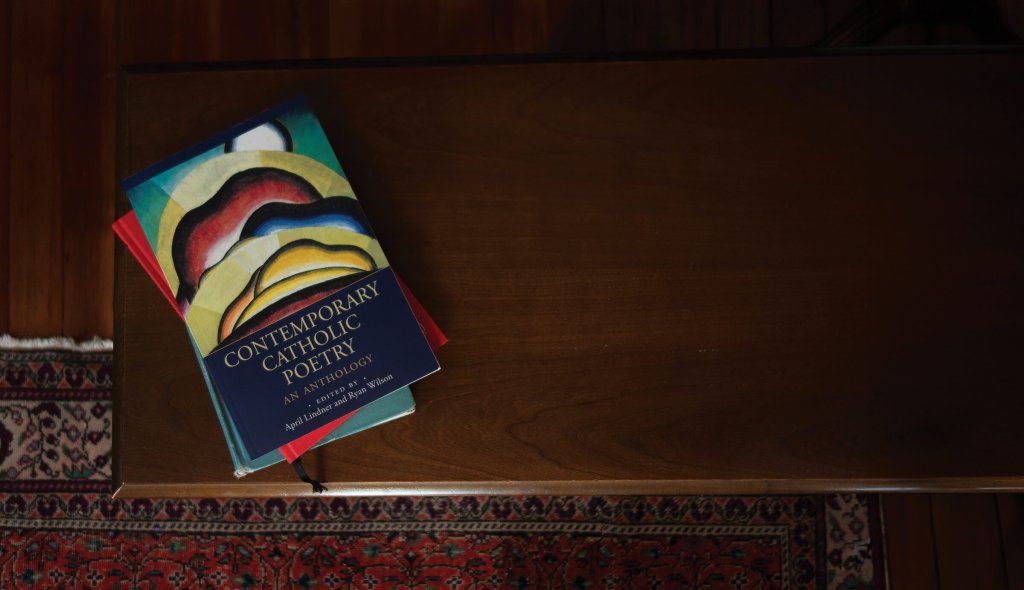
As the latest effort in this micro-genre, Contemporary Catholic Poetry: An Anthology is, I think, the best of the lot. The bulk of the book’s work comes from 23 U.S. poets, all of whom were born in 1950 or later, were baptized Catholic, had “not publicly and categorically disavowed Catholicism” and were “writing from within the context of their faith.”
The book’s preface, titled “Welcome, All Wonders,” provides an admirably concise introduction to poetry in general, followed by a history of the development of the category of “Catholic poetry in English.” For readers who complain that they just don’t “get” poetry, this is as good a place as any to begin.
While Joyce Kilmer began his anthology by boasting of a “renascence,” Lindner and Wilson tell a story of recent decline. From 1944 to 1969, they note, Catholics pulled down the Pulitzer Prize or National Book Award nine times. Many Catholics were among the top tier of poets in the United States—and twice a Catholic was named poet laureate. The faith itself was often the subject of popular works by major poets.
The last 50 years have not been as auspicious. Catholics have
vacated the public square, and identifiably “Catholic poetry” is largely confined to religious magazines. Yet, the poets in this book give us reason to hope. There is, in fact, a Pulitzer Prize winner in the collection: Franz Wright. And other contributors—Marie Howe, Carolyn Forché, Dana Gioia—have enjoyed appearances in the New Yorker and Poetry magazine.
But the art form itself has all but vanished from public consciousness. Those who know poetry know that this is a tragedy. Many who don’t know poetry, however, still worry that they’re missing something. This anthology shows what they’re missing. The poems are expertly chosen, exemplars of the art. Some poems engage matters of faith directly, others obliquely.
Contemporary poetry is a quilt of styles and techniques— from free verse to formalism, realism to surrealism—and all are represented in these pages. The poets here also reflect the Catholic Church in their racial, ethnic, socioeconomic and professional diversity. I found myself most moved by the poems of a Houston policewoman (Sarah Cortez); a gay, Ivy League- educated farmer (Timothy Murphy); and an actor (David Yezzi). But not one of the poets left me cold or baffled. The poems were selected well for craft and lucidity.
The difficulty in reviewing a successful anthology is that nothing inside is representative of the whole. The word “anthology” comes from the Greek compound meaning “a gathering of flowers.” What petal could convey the brilliance of the arrangement?
Mike Aquilina is the author of scores of books on Church history, including most recently Rabbles, Riots, and Ruins: Twelve Ancient Cities and How They Were Evangelized.
Contemporary Catholic Poetry: An Anthology, edited by April Lindner and Ryan Wilson. Paraclete Press–Iron Pen, 2024 240 pages; $35 (hardcover); $25 (paperback)
This article appeared in the February 2025 edition of The Catholic Telegraph Magazine.

More Book Reviews
- Joseph Pearce
- Anna Mitchell
- Gail Finke

Subscribe to the Ember
Weekly news from around the Archdiocese
Stay connected to our vibrant Catholic community! Sign up to receive our weekly digital newsletter The Ember. We’ll keep you informed and inspired with local news, fellowship opportunities, and event reminders.