St Francis Seraph Church to close
Franciscan Friars of the Province of Our Lady of Guadalupe Affirm Commitment to Cincinnati Amid Transitions
(Cincinnati, OH). The Franciscan Friars of the Province of Our Lady of Guadalupe announced plans to reassign friars and begin a transition that includes the sale of St. Francis Seraph Friary and Church. Even as this change moves forward, the friars affirm their longstanding commitment to serving the people of Cincinnati.
For more than 160 years, the Franciscan presence in Over-the—Rhine has been a source of faith, fraternity, and service. Since the dedication of St. Francis Seraph Church in 1859, generations of friars have walked alongside the community – celebrating Sacraments, offering pastoral care, proclaiming the Gospel and serving the most vulnerable. In 2023, the friars in Cincinnati became part of the unified Province of Our Lady of Guadalupe, formed with the hope of preserving Franciscan pastoral presence in the United States. Today the province serves diverse communities from Alaska to Puerto Rico, as well as missions in Cuba and Jamaica.
As the province continues to discern how best to steward its resources and respond to the needs of an aging fraternity, provincial leadership has made the difficult but prayerful decision to reassign the two remaining friars from St. Francis Seraph Church to ministry at St. Clement Catholic Church in St. Bernard, OH — ensuring that Franciscans maintain an active presence in Cincinnati. The Franciscan charism will endure in Over-the-Rhine at St. Francis Seraph School and through St. Francis Seraph Ministries that will continue to operate St. Anthony Center, serving the needs of many people in the area who are poor and unhoused.
St. Francis Seraph Friary, which shares a building with the church, has, with the exception of the parish office, remained vacant for the past two years. The last Mass at St. Francis Seraph Church will be celebrated Sunday, June 28, 2026.
The Provincial Council of the Province of Our Lady of Guadalupe extends a warm invitation to parishioners from St. Francis Seraph to join the friars at St. Clement Church.
“The testimony of your lives and your faith have been your gift to us. We have been blessed and privileged to be able to laugh and cry with you, to share Sacraments and meals with you, to grow together as disciples of Jesus Christ and to proclaim the Good News of Jesus Christ. We hope you will journey with us as we move to St. Clement Church after July.”
About the Franciscan Friars of the Province of Our Lady of Guadalupe (Order of Friars Minor)
The Franciscan Friars of the Province of Our Lady of Guadalupe form a coast-to-coast Catholic brotherhood devoted to living the Gospel in the manner of St. Francis of Assisi and in imitation of Jesus Christ. The friars’ work is rooted in prayer, fraternity, care for the poor, education, art and social justice. Founded in October 2023, the Province of Our Lady of Guadalupe was established through the unification of five U.S. provinces that belonged to the Order of Friars Minor, and includes missions in Puerto Rico, Alaska, Cuba and Jamaica. Combining their gifts has allowed the friars to renew their Franciscan witness to American society and begin an exciting new chapter of their long history in the United States. They go forth under the guidance of Our Lady of Guadalupe, patroness, whose compassion and advocacy for the oppressed and suffering calls them to live in solidarity with the marginalized. To learn more, visit friars.us and connect with @friarsguadalupe on Facebook, Instagram, X (Twitter) and LinkedIn.
History of St. Francis Seraph Parish by Fr. Greg Friedman, OFM
Over-the-Rhine neighborhood around St. Francis Seraph Church has witnessed many changes. Before it was named for a river in Germany, the neighborhood was simply the Northern Liberties. The name referred to the fact that the city of Cincinnati’s northern boundary or liberty was what is now known as Liberty Street.
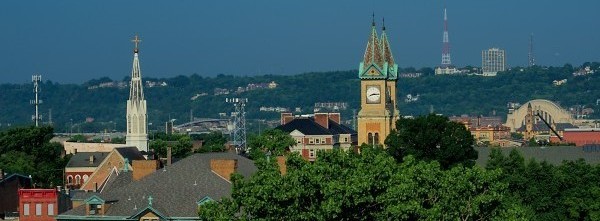
In the middle of the 19th Century, the area of Cincinnati now called Over-the-Rhine, was a bustling, crowded neighborhood, filled with businesses, factories and homes. Here the great waves of German immigrants had come to settle, raise families and worship together. Many of them were Catholic, so many that, by the time St. Francis Seraph Church was under construction in 1859, there were already eight German Catholic congregations. The largest of these, St. Johns, had over 700 families, with over 400 Baptisms a year.
It was under the care of the Franciscan Friars from the Austrian Tyrol, who had been recruited by Cincinnati Archbishop John Baptist Purcell to give pastoral care to German-speaking Catholics.
The phenomenal growth of the immigrant Catholic community by the middle of the century, coupled with the zeal of these friar-missionaries, led to the establishment of a permanent foundation (known as a custody) for the Franciscans in Cincinnati. The Archbishop agreed to support the friars in opening a seminary and an elementary school, as well as a residence for priests and brothers, and St. Francis Seraph, a ninth parish for German Catholics, located at Liberty and Vine Streets, a city block distant from St. Johns. The grateful Franciscans named their new community the Custody of St. John the Baptist after the Archbishop’s patron saint.
The site was historic: 40 years before, in April 1819, the first Catholics in Cincinnati built Christ Church, a frame building in the area known as the Northern Liberties, just beyond the city limits. They marked out a Catholic cemetery next to the church. In March 1822, Edward Fenwick, first bishop of Cincinnati, took possession of Christ Church as his cathedral. Later that year, the new bishop had Christ Church moved to a location downtown. The cemetery remained, while the city grew up around it.
In November 1858, the cornerstone was laid for the present St. Francis Seraph Church. The remaining bodies were entombed in a crypt below the altar of the new church, which was consecrated December 18, 1859.
Over the next years, the church was acquired the ornate decorations favored by the German Catholics. In July 1864, two large church bells were consecrated. In March 1868, a bronze statue of St. Francis placed over the church doors.
In 1869, and later again in 1875 and 1898, the church was adorned with frescoes, large paintings and other decorations.
A major change in the church building took place in 1907, coinciding with the building of a larger residence for the friars. The rear of the sanctuary was removed, and a choir for the friars added connecting with the friary. A new high altar, under a massive canopy or baldachino was added. In 1912, a Grotto of Our Lady of Lourdes was constructed in the rear of the church. In 1914, the entire church redecorated for a fifth time. In 1925, extensive improvements to the exterior of the church resulted in the distinctive veneer of glazed brick which looks reasonably fresh nearly 85 years later.
In 1950, the entire church was cleaned, interior decorations simplified, and most significantly the sanctuary was renovated, with the removal of the baldachino. The interior would remain largely untouched until the 1970s, when the liturgical reforms of the Second Vatican Council prompted removal of the high altar and communion railings. A large platform with a simple altar for concelebration, was constructed. Ceiling frescoes and other painted decorations disappeared under the simplified look favored by church renovation in those years.
In 2000, St. Francis Seraph Church was remodeled once again, removing the 1970s platform and altar, constructing a new sanctuary floor and altar, restoring the original sanctuary steps and replacing the entire floor of the main church. A baptismal pool was added in the rear of the church. Some years later, acoustical panels, matching the wall colors were added, and four historic painting, part of the 19th-century altar panels, were brought from storage to grace the side-altar shrines to St. Francis and the Blessed Virgin.
As the neighborhood around the parish and school changed, so did the friars ministry. New waves of immigrants this time from within the U.S.: Appalachians and African-Americans brought unique cultures, even as they struggled with economic and social problems. By the 1970s, the area was impoverished, parish population declined, and urban renewal changed the face of the neighborhood.
By the 1980s, the ministry of the Franciscans had shifted to include a larger focus on the social needs of the neighborhood, through a Contact Center, soup kitchen and other outreach efforts. St. Francis Seraph School remained an important resource for inner-city youth.
The social ministries of the Franciscans continued to develop into the 21st century, as the Sarah Center for women from the neighborhood, an emergency assistance program, and a daily hospitality center were added. The school and soup kitchen continue as part of a Franciscan outreach to the neighborhood, with assistance from many generous benefactors around Cincinnati.
In 2010, these services, which are now known as “St. Francis Seraph Ministries,” were incorporated into a separate not-for-profit corporation, a sponsored ministry of the Franciscan Friars. It continues the friars historic commitment to Over-the-Rhine in the area of social service, just as St. Francis Seraph Parish and its School continue the friars’ parochial and educational ministry. The Parish and Ministries are affiliated in a covenant, which expresses the relationship which the two share.
The Author