Book Review by Kenneth Craycraft
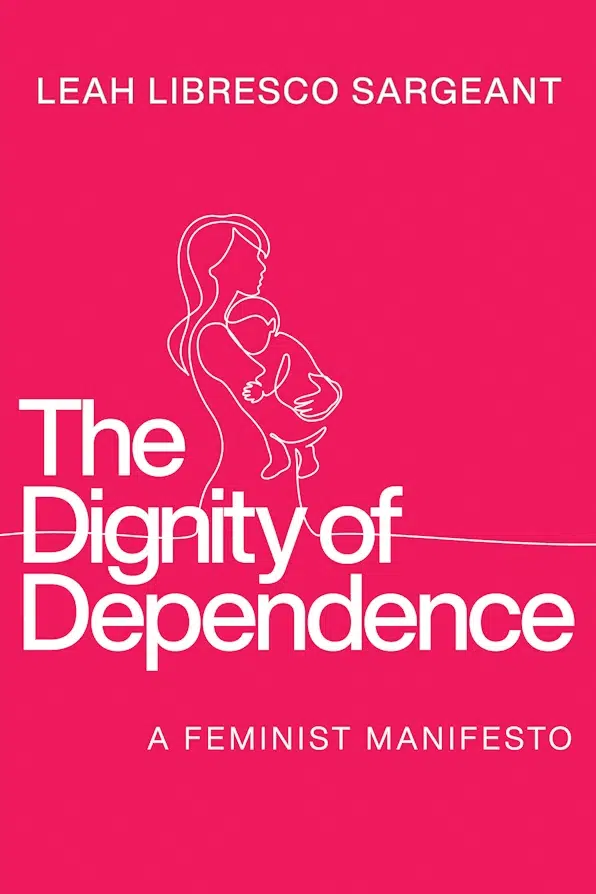
The Dignity of Dependence
By Leah Libresco Sargeant | University of Notre Dame Press, 2025 | 232 pages | $28.00.
In his inauguration speech as mayor of New York City, Zohran Mamdani declared, “We will replace the frigidity of rugged individualism with the warmth of collectivism.” This dichotomy is not merely a false choice; it is a false choice between two false alternatives. His statement illustrates not only the failure of political languages in the United States, but the lack of moral imagination of the modern secular mind more generally. Both individualism and collectivism are pernicious ideologies. Mamdani’s inability to conceive of social and political life outside this false choice of false options is a proxy for the general malaise of our times.
Ironically, collectivist ideology in the U.S. would probably not have arisen, but for the individualist ideology upon which it was founded. Collectivist impulses in the U.S. are downstream from individualist ideology. Collectivism is an untenable correction the social maladies produced by unsustainable individualism. In the U.S., we begin with an inadequate theory of the human person as an isolated, atomistic individual. But this false theory of moral libertarianism leads to the kinds of perennial conflicts that produce authoritarian collectivism as a purported antidote.
Individualism is the false assertion that we humans are naturally independent from one another and that authentic dignity is found only in self-reliance, self-determination, and autonomy. Of course, this implies that dependence and dignity are contradictory notions. If dignity is a measure of independence, then the dependent people cannot have dignity. Resistance to the reality of dependence compels us toward the social chaos and conflict of which “warm collectivism” is the purported antidote.
If we start with an acknowledgement of the social nature of the human person—a fundamental teaching of Catholic faith—we do not produce the false anthropology of individualism that leads to the false solution of collectivism. This is the principal insight of Leah Libresco Sargeant’s brilliant new book, The Dignity of Dependence: A Feminist Manifesto.
While the subtitle of Sargeant’s book is “A Feminist Manifesto,” and while the book concentrates on the disproportionate effect of individualism on women, The Dignity of Dependence carries a broader and more comprehensively hopeful message. It is both an acknowledgement and celebration of the natural dependency that we all have on one another and a rejection of false notions of autonomy that separate us. Dependency, Sargeant argues, is “[w]hat makes us most human.” It is not “a problem to get over,” but the natural state of the human person.
That said, Sargeant’s primary focus is the disproportionate effect of individualism on women. “Women’s bodies and relationships are shaped by dependence, which makes us exceptional and unwelcome in a world that expects men and women to be autonomous (or at least to pretend to be),” she writes. “A world that is unwilling to acknowledge dependence as foundational to human life is unable to treat women as equal in dignity to men.”
This is because a world shaped by men—especially men asserting autonomy as basic moral anthropology—necessarily relegates women to dependence on that world. So, the syllogism goes something like this: 1. Dignity is directly proportionate to autonomy. 2. U.S. culture is built around a theory of individualism that favors men and men’s bodies as the epitome of dignity. 3. This exposes women as inherently (though artificially) dependent. 4. Therefore, women have less dignity than men. Put another way, a moral and political culture that institutionalizes male autonomous individualism as the human norm is a culture that inevitably considers women to be defective humans. Leah Libresco Sargeant’s The Dignity of Dependence is both a brilliant analysis of this malady and a hopeful suggestion for overcoming it.
The Author